
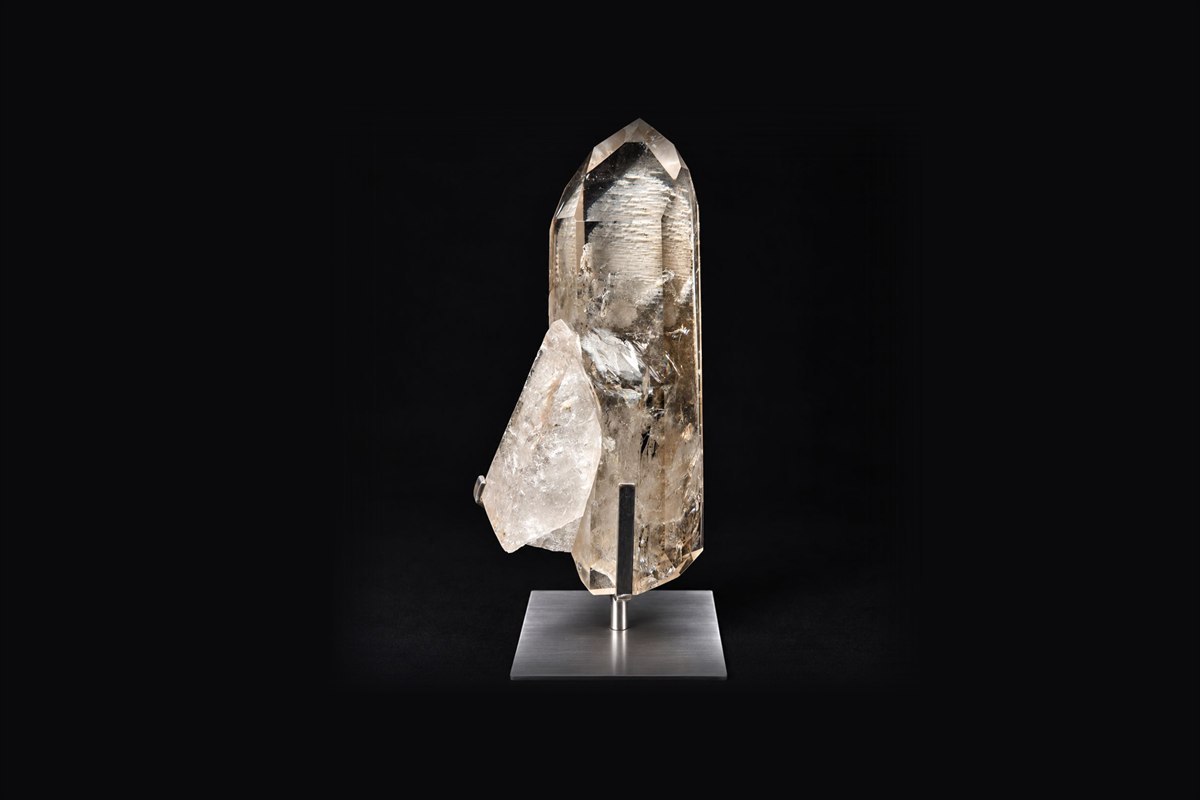
Quick answer: Most crystals are worth very little money, and a small minority are worth a great deal. Quartz is one of the most abundant minerals in the Earth’s continental crust and common amethyst is mined in quantity in Brazil, Uruguay and Zambia, which is why ordinary tumbled stones are inexpensive commodities. Instead, value concentrates in rarity, colour quality, size, integrity and provenance.
On the business question: yes, money is made selling crystals, but not from the stones appreciating. It comes from a sourcing advantage, curation, presentation and an audience, the same places margin comes from in any product business. Crystals are not a standardised, liquid asset class, and this article explains specifically why not.
What Makes Crystals Worth Real Money
Eight drivers, roughly in order of how much they move price:
- Rarity of the species. Abundance sets the floor. Quartz and common amethyst are genuinely plentiful; fine tourmaline, alexandrite and imperial topaz are not. No amount of presentation closes that gap.
- Colour quality. Within one species, saturation and evenness of colour is often the single largest multiplier. For example, deep, evenly coloured amethyst and pale patchy amethyst are the same mineral at very different prices.
- Size, especially intact size. Price per kilogram usually rises with piece size, because large undamaged formations are disproportionately rare. A 200 kg cathedral is not ten times a 20 kg one.
- Integrity. Fractures, chips, broken terminations, repaired bases and glued matrix all reduce value substantially, and they are also the flaws sellers most often hide in photographs.
- Formation and aesthetics. Termination quality, symmetry, contrast against matrix, and whether the piece stands unaided.
- Treatment status. Generally, natural material commands a premium over treated. Heat-treated citrine and dyed agate are standard, accepted trade practice, and they price as treated material, which is precisely why disclosure matters.
- Locality and provenance. For collectors, a specimen from a documented and now-exhausted locality can be worth multiples of visually identical material of unknown origin.
- Finish quality. For worked goods: polish, symmetry and base cut, which are labour, not geology.
Which Crystals Are Worth the Most Money
The gap between “a crystal” and “a valuable crystal” is enormous. At the top of the Brazilian range:
| Material | Why it commands a premium |
|---|---|
| Paraíba tourmaline | Copper-bearing elbaite with a distinctive neon blue-green colour, first found in the 1980s at São José da Batalha in Paraíba. Widely regarded as among the most expensive gemstones per carat in the world |
| Fine alexandrite | Colour-change chrysoberyl; Brazilian material from Minas Gerais gained a strong reputation. Extremely rare in fine quality |
| Imperial topaz | The Ouro Preto district in Minas Gerais is its main commercial source worldwide, which is unusually concentrated for a gem material |
| Fine emerald and aquamarine | Top-colour, high-clarity material in larger sizes is scarce at any origin |
| Exceptional specimens | Large, undamaged, well-formed pieces with documented locality: valued as specimens rather than as gem rough |
And at the other end: tumbled stones, small polished points, chips and common cluster material are inexpensive by the kilogram because supply is abundant. That is not a criticism. After all, a retail business needs those goods. It just means they do not store much value. More detail in What Is the Most Expensive Gemstone in Brazil?
Are Crystals Worth Money as an Investment?
Treat this carefully, because the honest answer is not the one most content on this subject gives.
Crystals and mineral specimens are not a standardised asset class, and four specific things follow from that:
- No standardised grading. Unlike diamonds, decorative mineral specimens have no general certification scheme. There is no independent grade you can quote to a future buyer. Laboratory reports exist for cut gemstones and do carry weight, but that is a different market from specimens and decor.
- Thin liquidity. The price a fine specimen realises depends on finding the specific buyer who wants that specific piece. That buyer may not exist this month.
- A wide spread. The difference between what a dealer pays and what a dealer charges is large, which means a piece bought at retail generally has to appreciate substantially before reselling breaks even.
- New supply. A new find can change the price of a material quickly. That is a real risk in minerals in a way it is not in most collectibles.
People do hold fine specimens for many years and realise gains, and the very top of the market has genuine collector depth. But it behaves like collecting (expertise, patience, relationships and access) not like a savings instrument. In short, anyone presenting crystals as a reliable store of value is selling something.
Can You Make Money Selling Crystals?
Yes, and the margin comes from the business, not from the stones. Four things determine whether a crystal business earns:
1. Where you buy in the chain
A stone can pass through miner, local dealer, exporter, importer and distributor before reaching a retailer, and each step adds margin. Where you enter that chain mostly determines your unit cost, not how hard you negotiate. This is the largest single lever available to a retailer, and it is a sourcing decision, not a selling one. See How Much Are Crystals Wholesale?
2. Your product mix
Stores concentrated in the cheapest tier get traffic and no margin. In contrast, the mid tier (clusters, towers, spheres, mid-size polished goods) is where the gross profit actually sits. Statement pieces earn partly by bringing people through the door rather than by turning quickly.
3. Presentation and audience
Two retailers selling identical material at identical cost can realise very different prices, because photography, display, description and trust support a price. In this category presentation is not decoration; it is a material part of what the customer is buying, since they cannot assess the stone technically.
4. Turn rate
A 70% margin on stock that moves once a year is worse than a 45% margin on stock that moves monthly. Crystal inventory is heavy, capital-intensive and easy to over-buy. Most crystal businesses that struggle are not struggling on margin percentage: they are struggling because capital is sitting on shelves.
The Honest Risks: When Crystals Are Not Worth the Money
- The low end is crowded. A very large number of sellers offer tumbled stones and small polished pieces at thin margins.
- Unique inventory is operationally expensive. You must photograph, measure, weigh, describe and list every one-of-a-kind piece individually. That per-unit labour is why cheap unique pieces often are not worth listing.
- Freight and breakage are structural, not incidental. Stone is dense and brittle. As a result, both costs are permanent features of the category.
- Capital gets stuck. Over-buying is the most common failure, and heavy goods are expensive to hold and to move on.
- Compliance exposure on claims. Marketing crystals with health or medical claims creates real regulatory risk in the United States (see the FTC Health Products Compliance Guidance). Sell the stone, not a treatment. See Do I Need a License to Sell Crystals?
How to Judge Whether Crystals Are Worth the Money Asked
- Identify the species and treatment status in writing before anything else.
- Compare against realised sales, not asking prices. What pieces list for and what they sell for are different numbers.
- Inspect integrity properly: ask for video in ordinary daylight, and specifically for the base and the reverse.
- Get exact weight and dimensions. “Large” is not a measurement, and on heavy pieces weight is also a freight cost.
- Ask what it would take to source another. If the answer is “easily”, it is not a scarce piece, whatever the listing says.
- Discount for anything undisclosed. A seller who will not state treatment status has told you how to price the risk.
Where CS Minerals Fits
CS Minerals is a Brazilian origin supplier, which is relevant to exactly one of the four levers above: the first, and the largest. Buying closer to origin is what gives a retailer room to price to their market rather than compete against everyone working from the same domestic catalog.
We are not going to tell you crystals are an investment, because they are not a standardised one. What we will do is quote Brazilian material on stated terms with treatment status disclosed, so the arithmetic in How to Price Crystals to Sell is possible to run before you commit.
How Much Money Crystals Are Worth to a Buyer Versus a Seller
The same stone carries two different numbers, and confusing them is where most disappointment comes from. To a seller it is worth the landed cost plus whatever the market will carry. To a buyer, however, it is worth whatever the piece does in the room it ends up in.
That gap is why crystals are rarely worth the same money at resale as at retail. A customer who paid two hundred dollars for a cathedral bought the object and the moment of choosing it, and neither transfers to the next buyer.
For a business, the useful test is not what a piece might fetch one day. It is whether it sells at your price within a season, because inventory that does not turn is capital you already spent.
Are Crystals Worth Money? Frequently Asked Questions
What are most crystals actually worth?
Most are worth little, because the common species are genuinely abundant: quartz is one of the most common minerals in the Earth’s continental crust. Value concentrates in rarity, colour quality, size, integrity, provenance and finish. A tumbled amethyst and a fine untreated Paraíba tourmaline are both “crystals” and are separated by several orders of magnitude in price.
Can you make money selling crystals?
Yes, but from the business rather than from the stones appreciating. The determinants are where you buy in the chain from mine to retailer, how your assortment is weighted across price tiers, how well you present and describe material, and how fast your inventory turns. No honest figure for earnings applies generally, because all four vary by operation.
Are crystals a good investment?
They do not behave like a standardised investment. Decorative mineral specimens have no general certification scheme, liquidity is thin because a sale depends on finding the specific buyer for that specific piece, the dealer spread is wide, and a new find can move the price of a material quickly. Fine specimens are collected successfully over long horizons, but that is collecting (expertise, patience and access) not a savings instrument. This is general information, not investment advice.
What is the most valuable crystal from Brazil?
Paraíba tourmaline is the strongest answer: a copper-bearing elbaite with a distinctive neon blue-green colour, first found in the 1980s at São José da Batalha in Paraíba, and widely regarded as among the most expensive gemstones per carat in the world. Fine alexandrite and imperial topaz from Minas Gerais also sit at the top of the Brazilian range.
Why are some crystals so cheap?
Because the supply is genuinely large. Common amethyst is mined in quantity in Brazil, Uruguay and Zambia, and quartz is abundant worldwide. Low price on ordinary tumbled or polished material usually reflects real abundance rather than anything being wrong with the stone: though some very cheap “crystal” is glass rather than mineral, which is a separate issue of disclosure.
Do crystals hold their value?
Common material generally does not, because it can be replaced easily and cheaply. Exceptional material (large, undamaged, well-coloured, with documented locality) holds value better, because it cannot. The determining question for any piece is how hard it would be to source another like it.
Request Wholesale Access
Building a crystal business? The largest lever is where you buy. Request wholesale access to CS Minerals for Brazilian material quoted on stated terms.
About CS Minerals
CS Minerals is a Brazilian supplier of crystals, minerals and natural stones serving wholesale buyers, retailers and professional buyers in the United States. The company combines Brazilian sourcing, product curation, live selling and international logistics to connect buyers with Brazilian stones and minerals.
Written by the CS Minerals Wholesale Team · Last updated
General commercial information. Not investment, financial, tax or legal advice, and not a representation that any business or purchase will produce a particular result. Crystals are sold here as natural stone and decorative objects; no health or therapeutic claims are made.
Comments
3 responses to “Are Crystals Worth Any Money?”
[…] That reasoning is worked through in Are Crystals Worth Any Money? […]
[…] reading: Are Crystals Worth Any Money? and How to Sell Crystals […]
[…] Related reading: How to Price Crystals to Sell and Are Crystals Worth Any Money? […]