
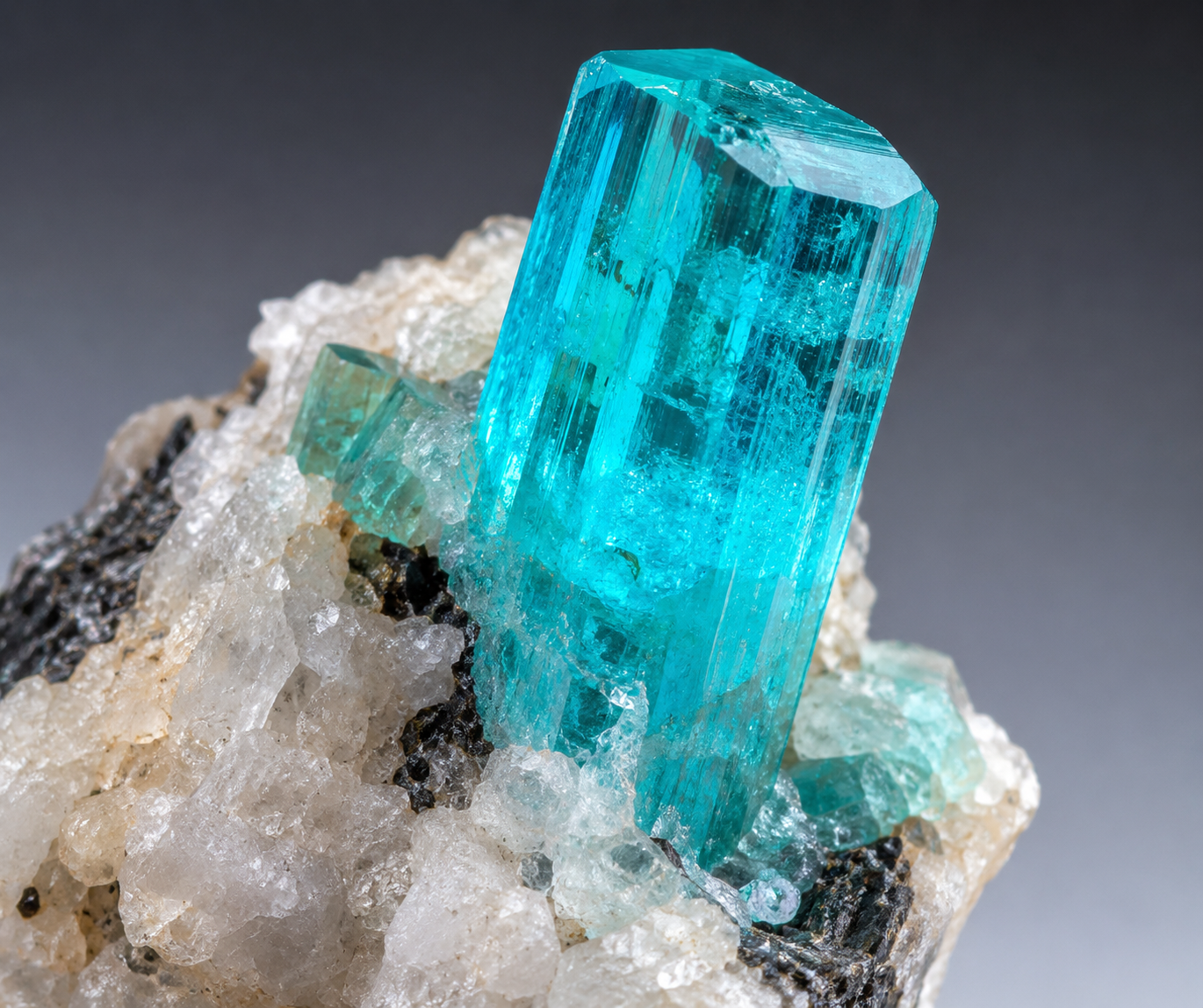
Quick answer: The most expensive gemstone in Brazil is Paraíba tourmaline. It is a copper-bearing elbaite tourmaline with a distinctive neon blue-to-green colour, first found in the 1980s at São José da Batalha in the state of Paraíba. The trade also widely regards it as among the most expensive gemstones per carat in the world, and in top qualities it can exceed fine ruby, emerald and sapphire.
Behind it, three other Brazilian materials command exceptional prices: fine alexandrite, the colour-change chrysoberyl; imperial topaz, whose main commercial source in the world is a single district in Minas Gerais; and top-colour emerald and aquamarine. Several orders of magnitude in price separate all four from ordinary Brazilian crystal.
Paraíba Tourmaline: the Most Expensive Gemstone in Brazil
What it is
Chemically it is elbaite, a lithium tourmaline, coloured by copper, which is unusual, because copper is not a normal colouring element in tourmaline. As a result, that composition produces a saturated, almost electric blue-to-green that has no close equivalent among other gemstones, and which reads as luminous even in modest light.
Where it came from
The material was first found in the 1980s at São José da Batalha, in the Brazilian state of Paraíba, from pegmatite deposits. The find was small in scale, and miners worked the deposits intensively, which is a central part of the price story: the original Brazilian source was never large.
Why it is the most expensive gemstone in Brazil
- Colour with no substitute. Buyers who want that specific neon blue-green therefore have no alternative material to switch to.
- Very limited supply. The Brazilian deposits are small, and fine material in larger sizes is especially rare.
- Size scarcity compounds. As with most gems, price per carat rises steeply with size, and in this material clean stones above a few carats are exceptional.
- Established collector and high-jewelry demand. The top of the jewelry market has adopted the stone, which supports the price.
The naming nuance that matters commercially
After the Brazilian discovery, copper-bearing tourmaline was also found in Nigeria and Mozambique. Consequently, the trade came to use “Paraíba” as a designation for the material type (cuprian elbaite in that colour range) rather than strictly for the geographic origin. African material can be visually similar, although it generally trades below Brazilian-origin stones of comparable appearance.
Practical consequence for a buyer: for stones of significant value, origin determination matters and belongs in an independent laboratory report, not in a seller’s assurance. This is one of the few areas in the crystal and gem trade where laboratory documentation genuinely changes the price. For background on the species itself, see the GIA guide to tourmaline.
Alexandrite: Another Expensive Gemstone From Brazil
Colour-change chrysoberyl: it appears green or bluish-green in daylight and then shifts toward red or purplish-red under incandescent light. The strength and cleanliness of that change is what sets the price, alongside the usual clarity and size factors.
Brazilian alexandrite, notably from the Hematita area of Minas Gerais, built a strong international reputation. Fine material, however, is extremely rare in any size, and top stones sit comfortably in the same price bracket as the best coloured gems in the world.
Imperial Topaz: An Expensive Gemstone With One Main Source in Brazil
Imperial topaz ranges from golden yellow through orange to a reddish-pink, with the pinkish and reddish tones commanding the highest prices. Its claim to a top position is structural rather than purely aesthetic: the Ouro Preto district in Minas Gerais is its main commercial source in the world. In fact, very few gem materials are that concentrated in a single district, and that concentration is a large part of the premium.
It is also the Brazilian stone with the strongest historical identity, tied to Ouro Preto and to the mining history of Minas Gerais.
Emerald and Aquamarine
Brazil produces both in commercial quantity, but at ordinary grades neither is expensive. At the top of the range, however, they are a different proposition: top-colour emerald with good clarity, and large clean aquamarine in intense blue, are scarce at any origin and priced accordingly.
Brazil has a strong aquamarine reputation. The Dom Pedro aquamarine (cut from a crystal found at Pedra Azul in Minas Gerais and now in the Smithsonian National Museum of Natural History) is the largest cut aquamarine gem known, at roughly 10,363 carats.
How the Most Expensive Gemstone in Brazil Compares: Relative Ranking
| Material | Position | What drives the price | Main Brazilian source |
|---|---|---|---|
| Paraíba tourmaline | Highest | Unique copper-derived colour; very small original deposits | Paraíba (São José da Batalha) |
| Fine alexandrite | Very high | Strength of colour change; extreme rarity in fine quality | Minas Gerais (Hematita), Bahia, Espírito Santo |
| Imperial topaz | High | Single dominant world source; reddish-pink tones rarest | Minas Gerais (Ouro Preto district) |
| Top-colour emerald | High | Colour and clarity at the top grades | Minas Gerais, Goiás, Bahia |
| Fine large aquamarine | Moderate to high | Intensity of blue plus clean material in large sizes | Minas Gerais, Espírito Santo |
| Fine specimen minerals | Variable, can be very high | Size, condition, aesthetics and documented locality | Various |
We do not publish per-carat figures here deliberately. Prices in this bracket vary enormously with quality, size, treatment and market conditions, so a fixed number in an article becomes misinformation within months. Instead, for a specific stone, the reference points that matter are a current independent laboratory report and recent comparable sales.
What Determines Price Within a Species
Across all of the above, the same variables apply in roughly the same order:
- Colour: saturation, hue and evenness. Usually the dominant factor.
- Clarity: eye-clean material commands a large premium in gem-quality stones.
- Size: price per carat rises steeply, because large clean crystals are disproportionately rare.
- Cut quality: for faceted stones, proportions and finish.
- Treatment: untreated material commands a premium; sellers must disclose treatments.
- Origin, where it is trade-significant: as with Paraíba tourmaline, and verified by laboratory report rather than by claim.
“Most Expensive” Is Not the Same as “Most Valuable to a Business”
This distinction is worth stating plainly, because the search question and the commercial question have different answers.
Paraíba tourmaline is the most expensive Brazilian gemstone per carat. It is also, for almost every retailer, the wrong thing to build a business on: supply is scarce, capital per unit is high, the buyer pool is small and specialised, and authentication carries real cost and risk.
The materials that actually generate revenue for Brazilian stone businesses are the abundant ones (amethyst, quartz varieties, agate and decorative worked stone) because they turn, they can be reordered, and they serve buyers who exist in volume. In short, value in a retail business comes from turn rate and margin, not from the price ceiling of the category.
That reasoning is worked through in Are Crystals Worth Any Money?
Sourcing Brazilian Material
CS Minerals supplies Brazilian crystals, minerals and natural stones (amethyst, quartz, agate, tourmaline, beryls and decorative stone) to wholesale and professional buyers in the United States, with treatment status disclosed per lot.
Request wholesale access for current availability.
Related reading: What Crystals Are Commonly Found in Brazil?, What Is Brazil’s National Gemstone? and What Country Is Famous for Crystals?
Most Expensive Gemstone in Brazil: Frequently Asked Questions
Which Brazilian gem costs the most?
Paraíba tourmaline: a copper-bearing elbaite with a distinctive neon blue-to-green colour, first found in the 1980s at São José da Batalha in the state of Paraíba. The trade widely regards it as among the most expensive gemstones per carat in the world, and in top qualities it can exceed fine ruby, emerald and sapphire.
Why is Paraíba tourmaline so expensive?
Four reasons work together. First, its copper-derived neon colour has no substitute among other gemstones. Second, the original Brazilian deposits were small. Third, clean stones above a few carats are exceptionally rare. Finally, the material has established demand in high jewelry and among collectors. In other words, scarcity and non-substitutability reinforce each other.
Is all Paraíba tourmaline from Brazil?
No. After the Brazilian discovery, copper-bearing tourmaline was also found in Nigeria and Mozambique, and the trade came to use “Paraíba” for the material type rather than strictly for the origin. African material can look similar and generally trades below Brazilian-origin stones of comparable appearance, which is why origin determination for valuable stones belongs in an independent laboratory report rather than in a seller’s assurance.
What is Brazil’s most valuable gemstone after Paraíba tourmaline?
Fine alexandrite, the colour-change chrysoberyl, with Brazilian material from the Hematita area of Minas Gerais holding a strong reputation. Imperial topaz then follows, with an unusual claim: the Ouro Preto district in Minas Gerais is its main commercial source worldwide. Top-colour emerald and large fine aquamarine are also in the high bracket.
How much is Brazilian imperial topaz worth?
It varies widely with colour, clarity, size and cut: reddish-pink tones are the rarest and command the highest prices, while pale yellow material is far more accessible. Because prices in this bracket move with quality and market conditions, the meaningful reference for a specific stone is a current laboratory report and recent comparable sales, not a published figure.
Which Brazilian crystal is best for a retail business?
Not the most expensive one. Amethyst, quartz varieties, agate and decorative worked stone generate retail revenue because they can be reordered, they turn, and they serve buyers who exist in volume. In contrast, Paraíba tourmaline has the highest price ceiling and the smallest, most specialised buyer pool: a different business entirely.
About CS Minerals
CS Minerals is a Brazilian supplier of crystals, minerals and natural stones serving wholesale buyers, retailers and professional buyers in the United States. The company combines Brazilian sourcing, product curation, live selling and international logistics to connect buyers with Brazilian stones and minerals.
Written by the CS Minerals Wholesale Team · Last updated
General reference information, not a valuation or appraisal. Gemstone prices vary with quality, size, treatment and market conditions. For a specific stone, rely on an independent laboratory report and recent comparable sales.
Comments
4 responses to “What Is the Most Expensive Gemstone in Brazil?”
[…] reading: What Crystals Are Commonly Found in Brazil?, What Is the Most Expensive Gemstone in Brazil? and Where Can I Buy Brazilian Crystals […]
[…] And at the other end: tumbled stones, small polished points, chips and common cluster material are inexpensive by the kilogram because supply is abundant. That is not a criticism. After all, a retail business needs those goods. It just means they do not store much value. More detail in What Is the Most Expensive Gemstone in Brazil? […]
[…] reading: What Crystals Are Commonly Found in Brazil?, What Is the Most Expensive Gemstone in Brazil? and What Country Is Famous for […]
[…] reading: What Is the Most Expensive Gemstone in Brazil?, What Is Brazil’s National Gemstone? and What Country Is Famous for […]