
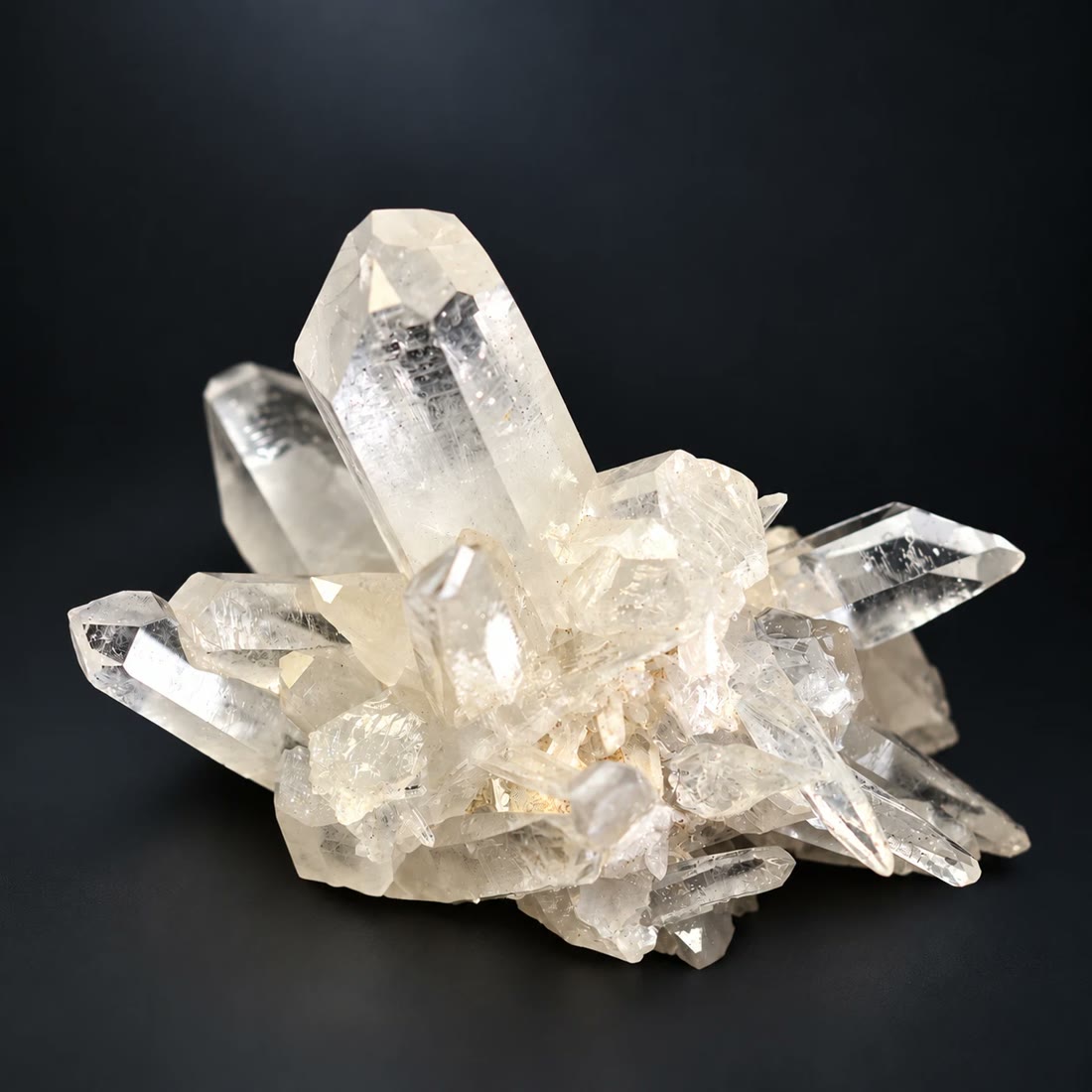
Quick answer: The crystals most commonly found in Brazil are quartz and its varieties (clear quartz, amethyst, smoky, rose and rutilated quartz), agate and chalcedony, tourmaline, the beryl family (aquamarine, emerald, morganite, heliodor) and topaz, including the imperial topaz whose main commercial source in the world is the Ouro Preto district in Minas Gerais.
Brazil produces this range because it contains three distinct geological environments rather than one: ancient granitic pegmatites in the eastern states, hydrothermal quartz veins, and the gas cavities of Cretaceous basalt flows in the south that host amethyst and agate geodes. Each produces a different family of material, which is why a single country supplies both faceting-grade gem rough and amethyst cathedrals weighing hundreds of kilograms.
Why So Many Different Crystals Are Found in Brazil
Brazil covers roughly 8.5 million square kilometers, built largely on ancient Precambrian cratons and overlaid in places by much younger volcanic rock. Three settings account for nearly all commercially traded Brazilian crystal:
| Geological setting | How it forms | What it produces | Where |
|---|---|---|---|
| Granitic pegmatites | Coarse-grained intrusive bodies cooling slowly, allowing very large, well-formed crystals to grow | Tourmaline, beryl, topaz, spodumene, gem-quality quartz | Minas Gerais, Espírito Santo, Bahia, Paraíba, Rio Grande do Norte |
| Hydrothermal quartz veins | Mineral-rich hot fluids depositing silica in fractures | Clear, smoky and rutilated quartz | Bahia, Minas Gerais, Goiás |
| Basalt vesicles | Cretaceous lava flows cooled with gas cavities trapped inside; the cavities later filled with silica-bearing fluids | Amethyst and agate geodes, cathedrals, druze plates | Rio Grande do Sul, Santa Catarina, Paraná (the Paraná Basin) |
The practical consequence: pegmatite material and geode material come from different states, different mining operations and different price logics. In other words, they are effectively two industries inside one country.
Quartz: the Most Common Crystals Found in Brazil
Quartz is one of the most abundant minerals in the Earth’s continental crust, and Brazil is among its most significant sources. It is also the most commercially important family here, because it spans every price tier.
- Clear quartz (rock crystal) is colourless and sold as points, clusters and polished goods, mainly from Bahia, Minas Gerais and Goiás.
- Amethyst is purple and comes as geodes, cathedrals, clusters, druze and polished points, above all from Rio Grande do Sul (Ametista do Sul and the Alto Uruguai district).
- Citrine runs from yellow to orange and also comes from Rio Grande do Sul, where Soledade processes it; see the note below on treatment.
- Smoky quartz is brown to near-black and sold as points and polished pieces from Minas Gerais and Bahia.
- Rose quartz is pink and usually massive rather than crystalline, so workshops mostly carve and polish it; it comes from Minas Gerais and Bahia.
- Rutilated quartz is clear quartz with golden needles of rutile, and it commands a premium; the classic source is the Novo Horizonte area of Bahia.
- Tourmalinated quartz contains black tourmaline needles and likewise comes from Minas Gerais and Bahia.
- Aventurine is green with a glittering, mica-like effect, and Brazilian material comes mainly from Bahia and Minas Gerais.
Two treatments worth knowing, because reputable suppliers disclose them:
Citrine. A large share of the commercial citrine on the market is amethyst that has been heat-treated to shift its colour to yellow or orange. This is long-standing, accepted trade practice, but suppliers must declare it, and it prices as treated material.
Prasiolite (green quartz). Heat-treating amethyst also produces most commercial material. Naturally green quartz exists, although it is uncommon.
Agate and Chalcedony
Banded chalcedony formed in the same basalt cavities as the amethyst of southern Brazil. Agate is the backbone of Brazilian decorative stone: cutters turn it into slices, bookends, coasters, bowls, spheres, lamp bases and jewelry components, and it takes dye readily, which is why brightly coloured agate slices are common and why sellers have to disclose dyeing, like heating.
The main region is Rio Grande do Sul, particularly around the Salto do Jacuí area, with cutting and processing concentrated in Soledade.
Tourmaline: High-Value Crystals Found in Brazil’s Pegmatites
Brazilian pegmatites produce tourmaline in a very wide colour range: black (schorl), green and pink elbaite, bicolour and “watermelon” sections, and the copper-bearing material from Paraíba.
Paraíba tourmaline is the exceptional case. A cuprian elbaite with a distinctive neon blue-to-green colour, it was first found in the 1980s at São José da Batalha in the state of Paraíba. Because copper-bearing tourmaline was subsequently found in Nigeria and Mozambique, the trade came to use “Paraíba” as a designation for the material type rather than strictly for the origin, so for Brazilian-origin stones, origin documentation matters commercially. Many in the trade regard it as among the most expensive gemstones per carat in the world.
Main tourmaline regions: Minas Gerais, Espírito Santo, Bahia, Rio Grande do Norte and Paraíba. For a gemmological overview of the species, see the GIA guide to tourmaline.
The Beryl Family
- Aquamarine is blue to blue-green and comes from Minas Gerais, Espírito Santo and Bahia.
- Emerald is the green variety, mined in Minas Gerais (Nova Era and Itabira), Goiás (Santa Terezinha) and Bahia (Carnaíba).
- Morganite, by contrast, is pink to peach and comes mainly from Minas Gerais.
- Heliodor is yellow to golden and also comes from Minas Gerais and Espírito Santo.
Brazil has a long-standing association with aquamarine. The Dom Pedro aquamarine, cut from a crystal found at Pedra Azul in Minas Gerais and now held by the Smithsonian National Museum of Natural History, is the largest cut aquamarine gem known, at roughly 10,363 carats.
Topaz
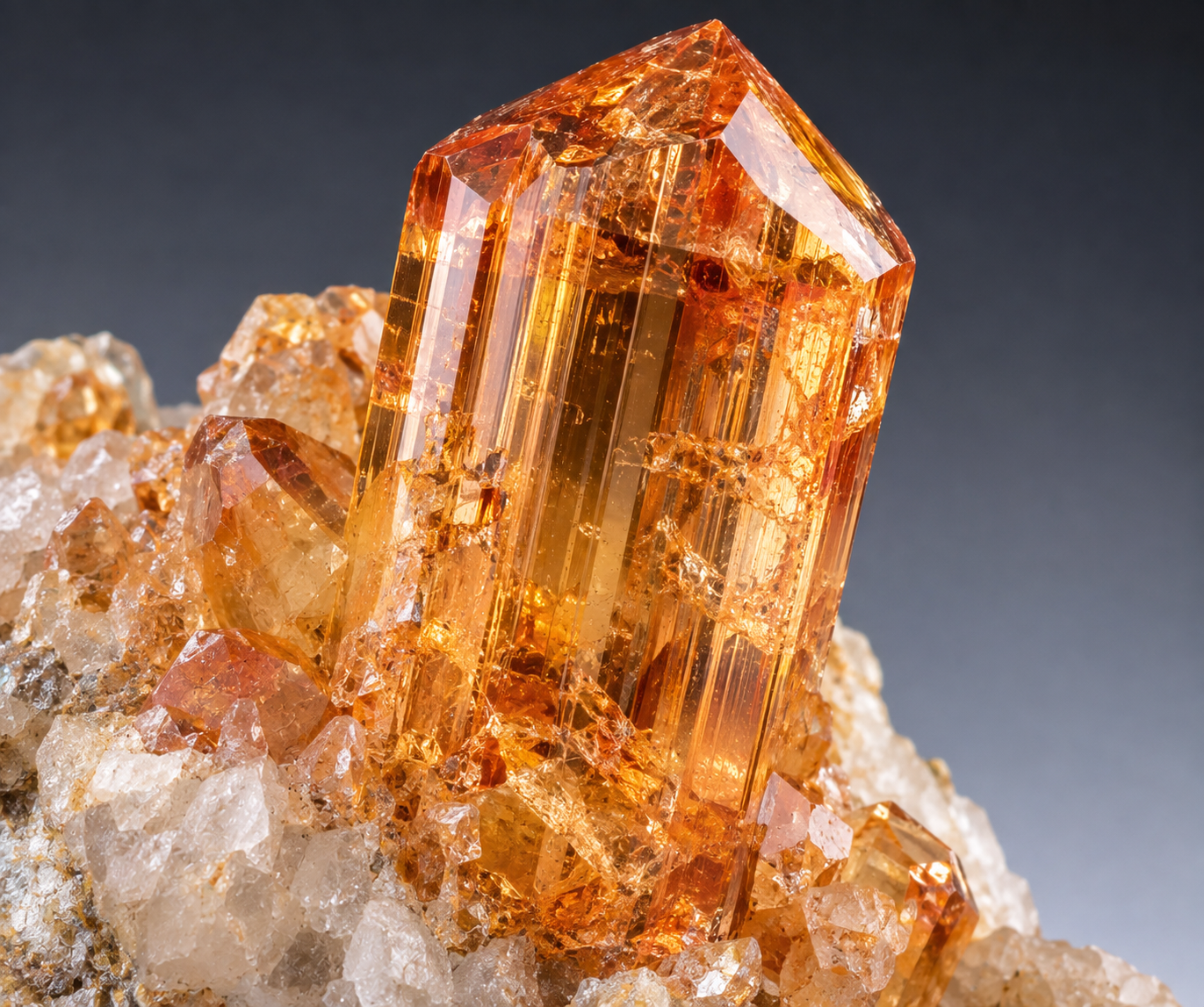
Brazil produces both common topaz and the variety that made it famous. Imperial topaz (ranging from golden yellow through orange to reddish-pink) comes principally from the Ouro Preto district in Minas Gerais, which is its main commercial source worldwide. That degree of concentration in a single district is unusual for a gem material, and it is therefore a large part of why the stone carries a premium.
Irradiating and heating colourless topaz very often produces the blue topaz on the market. Naturally blue topaz exists but is far less common, and sellers should disclose the distinction.
Other Notable Crystals and Minerals Found in Brazil
- Brazilianite is a sodium aluminium phosphate first described in 1945 from Minas Gerais and named after Brazil, which makes it the country’s namesake mineral; collectors prize it, especially from Divino das Laranjeiras and nearby.
- Alexandrite is colour-change chrysoberyl. Brazilian material, notably from the Hematita area of Minas Gerais, built a strong reputation, although fine quality is extremely rare; it also occurs in Bahia and Espírito Santo.
- Kunzite and spodumene form pink to lilac pegmatite crystals in Minas Gerais, often large and well formed.
- Euclase is a rare beryllium silicate for collectors, and Brazilian material from the Ouro Preto area is classic.
- Apatite forms blue-green crystals in Minas Gerais, mainly as collector and specimen material.
- Hematite and specularite are iron oxides with a metallic lustre from Minas Gerais (the “Iron Quadrangle”), and they also have decorative uses.
- Cassiterite is tin oxide from Rondônia, traded as both specimen and industrial material.
- Diamond is historically significant, because Brazil was a major world source before the African discoveries; the classic areas are Diamantina and Coromandel in Minas Gerais, plus Mato Grosso and Bahia.
Where Crystals Are Found in Brazil: Regions at a Glance
| State | Setting | Characteristic material |
|---|---|---|
| Minas Gerais | Pegmatite province | Tourmaline, aquamarine and other beryls, imperial topaz, quartz, alexandrite, brazilianite, kunzite |
| Rio Grande do Sul | Basalt vesicles | Amethyst geodes and cathedrals, agate, heat-treated citrine |
| Bahia | Veins and pegmatites | Rutilated quartz, clear and smoky quartz, amethyst, emerald, aventurine |
| Espírito Santo | Pegmatite province | Beryl, tourmaline |
| Paraíba | Pegmatite | Cuprian (Paraíba) tourmaline |
| Goiás | Schist-hosted deposits | Emerald, quartz |
| Rondônia | Granite-related | Cassiterite, topaz |
Two towns are worth knowing because material concentrates through them: Teófilo Otoni in Minas Gerais is the main trading center for Brazilian coloured stones, and Soledade in Rio Grande do Sul is the cutting and processing hub for agate and amethyst.
Which of These Matter Commercially
For a retailer or designer sourcing from Brazil, the practical shortlist is narrower than the full mineralogical list:
- Amethyst: the category most associated with Brazil, available from small retail pieces up to cathedrals of several hundred kilograms.
- Quartz varieties: the workhorse, covering every price tier.
- Agate: the basis of most repeatable Brazilian decorative goods.
- Tourmaline: the highest per-gram value in most mixed orders.
- Beryls and topaz: primarily for jewelry and collector channels.
The collector minerals (brazilianite, euclase, fine apatite) trade in a different market, priced on locality and specimen quality rather than on decorative appeal.
Sourcing Brazilian Material
CS Minerals is a Brazilian supplier of crystals, minerals and natural stones, sourcing at origin across Brazilian producing regions and selling to wholesale and professional buyers in the United States, with treatment status disclosed per lot.
Request wholesale access for current availability, or read Brazilian Crystal Wholesale Supplier for how a direct order from Brazil actually works.
Related reading: What Is the Most Expensive Gemstone in Brazil?, What Is Brazil’s National Gemstone? and What Country Is Famous for Crystals?
Which Crystals Found in Brazil Sell Best at Retail
Brazil produces far more species than any shop can stock, so the useful question is narrower than the geological one. Which of them move at retail, and in what form?
Four consistently carry independent shops, and the reason in each case is different:
- Amethyst because customers who know nothing about minerals recognise it on sight, and it works at every price point from a tumbled stone to a cathedral.
- Agate because slices and bookends sell as decor to buyers who would never call themselves crystal customers.
- Clear and smoky quartz because points and clusters are the default gift in this category.
- Rose quartz because it carries an association that needs no explanation at the counter.
Tourmaline, aquamarine and imperial topaz appear in the same catalogues but belong to a different business. Dealers sell them per carat, to a buyer who arrived already knowing what they wanted.
What Crystals Are Found in Brazil? Frequently Asked Questions
Which crystals is Brazil famous for?
Quartz and its varieties (clear quartz, amethyst, smoky, rose and rutilated quartz) along with agate and chalcedony, tourmaline, the beryl family (aquamarine, emerald, morganite, heliodor) and topaz. Brazil also produces collector minerals including brazilianite, alexandrite, kunzite, euclase and apatite.
Where is amethyst found in Brazil?
Mainly in Rio Grande do Sul, in the Ametista do Sul and Alto Uruguai district, where it formed inside gas cavities in Cretaceous basalt flows of the Paraná Basin. Soledade, in the same state, concentrates the cutting and processing.
What is Brazil’s most famous mineral?
By trade volume and recognition, amethyst. For scientific association, it is brazilianite: a phosphate mineral first described in 1945 from Minas Gerais and named after the country. Measured by value per carat, Paraíba tourmaline leads. Imperial topaz has a distinct claim because the Ouro Preto district in Minas Gerais is its main commercial source worldwide.
Is Brazilian citrine natural?
A large share of commercial citrine is amethyst that has been heat-treated to shift its colour. This is long-standing, accepted trade practice, not a deception, but sellers must disclose it, and treated material prices differently from natural. Naturally occurring citrine exists, although it is less common. So always ask for treatment status in writing.
Which Brazilian state produces the most gemstones?
Minas Gerais is the most important gem-producing state, because of its extensive granitic pegmatites, the source of tourmaline, aquamarine and other beryls, imperial topaz, alexandrite and much of the country’s fine quartz. Rio Grande do Sul, on the other hand, dominates a different category entirely: amethyst and agate geodes from basalt.
Why does Brazil have so many crystals?
Because it contains several distinct geological environments rather than one. Ancient granitic pegmatites in the eastern states grew large, well-formed gem crystals; hydrothermal veins deposited quartz; and Cretaceous basalt flows in the south trapped gas cavities that later filled to form amethyst and agate geodes. As a result, each setting produces a different family of material.
About CS Minerals
CS Minerals is a Brazilian supplier of crystals, minerals and natural stones serving wholesale buyers, retailers and professional buyers in the United States. The company combines Brazilian sourcing, product curation, live selling and international logistics to connect buyers with Brazilian stones and minerals.
Written by the CS Minerals Wholesale Team · Last updated
Geological and locality information is provided as general reference. Mineral occurrences and active production areas change over time; always confirm treatment status per lot with your supplier.
Comments
6 responses to “What Crystals Are Commonly Found in Brazil?”
[…] Detail on what the country actually produces: What Crystals Are Commonly Found in Brazil? […]
[…] reading: What Crystals Are Commonly Found in Brazil?, What Is the Most Expensive Gemstone in Brazil? and What Country Is Famous for […]
[…] To learn more about working with a Brazilian wholesale supplier, see our guide to buying directly from Brazil. For a deeper look at Brazil’s extraordinary mineral diversity and geological origins, explore what crystals are found in Brazil. […]
[…] reading: What Crystals Are Commonly Found in Brazil?, What Is Brazil’s National Gemstone? and What Country Is Famous for […]
[…] A supplier in a producing region sees far more material than any single US warehouse stocks. You can ask for a specific color grade of amethyst, a matched pair of agate bookends or a cathedral of a certain height. For a sense of what the country produces, see our overview of crystals found in Brazil. […]
[…] Buying straight from Brazil removes at least one layer of margin and puts you close to the source of amethyst, citrine, agate, clear quartz and large geodes. In return, you take on the import process yourself or through a customs broker. For more on the country’s output, see our guide to crystals found in Brazil. […]