
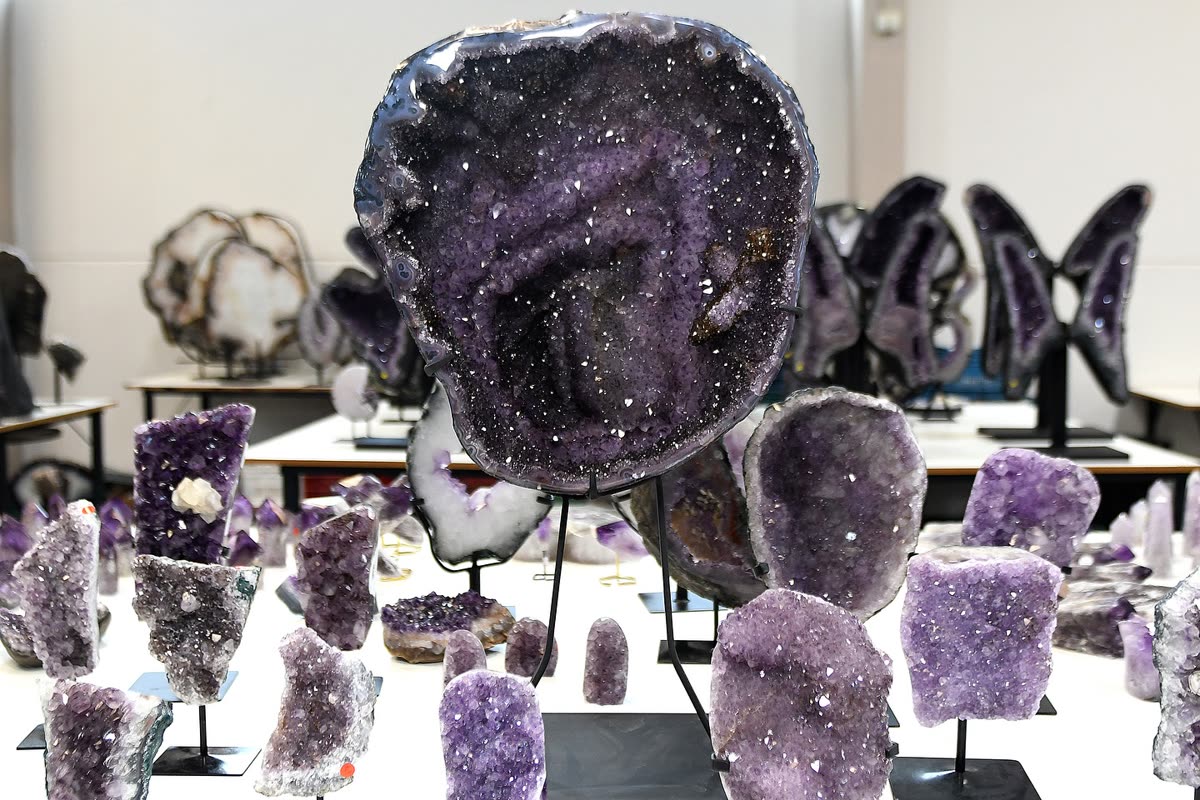
Brazilian crystal supplier guide · Wholesale
By the CS Minerals Wholesale Team
Last updated
Quick answerA Brazilian crystal wholesale supplier is a company that sources crystals, minerals and natural stones from Brazilian mining regions and sells them in commercial quantities to retailers, designers, collectors and other business buyers. US retailers can and do buy directly from Brazil. Buyers select pieces from photos, video or live sales. The supplier then packs them for transit and ships them by air or ocean freight. The goods then clear US customs under the importer’s own tariff classification.
Buying direct generally means wider selection, access to one-of-a-kind pieces and origin-level pricing. Buying from a US distributor generally means faster delivery, smaller minimums and no customs paperwork. This guide covers what Brazil actually produces, who buys it wholesale, how a direct order works step by step, how to vet a supplier, and how the two sourcing routes compare.
Why Brazil Is One of the World’s Most Important Sources of Crystals
Brazil is one of the leading producers of colored gemstones and quartz in the world. It holds that position for a structural reason. The country contains several completely different geological environments, and each one produces a different family of crystals. A supplier based in Brazil can therefore fill an order spanning faceting-grade rough, tumbled stones and a 300-kilogram amethyst cathedral. Very few single countries can cover that range.
Geological diversity
Brazil covers roughly 8.5 million square kilometers, built largely on ancient Precambrian cratons and overlaid in places by much younger volcanic rock. Three of those settings matter commercially:
- Granitic pegmatites. Coarse-grained intrusive bodies, concentrated in the eastern states, where slow cooling allowed very large, well-formed crystals to grow. This is the source of tourmaline, beryl (aquamarine and emerald), topaz and gem-quality quartz.
- Hydrothermal quartz veins. Mineral-rich hot fluids moving through fractures, depositing clear quartz, smoky quartz and rutilated quartz.
- Basalt flows of the Paraná Basin. Cretaceous lava flows across southern Brazil cooled with gas cavities trapped inside. Those cavities later filled with silica-bearing fluids, forming the agate and amethyst geodes the region is known for.
The practical consequence for a buyer: pegmatite material and geode material come from different states, different mining operations and different price logics. A supplier who can source both is consolidating two supply chains on your behalf.
Brazilian crystal regions a supplier sources from
| Region | Geological setting | Characteristic material |
|---|---|---|
| Minas Gerais | Pegmatite province | Tourmaline, aquamarine and other beryls, quartz crystals, imperial topaz from the Ouro Preto district |
| Rio Grande do Sul | Basalt vesicles (Alto Uruguai / Ametista do Sul district) | Amethyst geodes and cathedrals, agate, heat-treated citrine |
| Bahia | Quartz veins and pegmatites | Rutilated quartz from the Novo Horizonte area, clear and smoky quartz, amethyst |
| Espírito Santo | Pegmatite province | Beryl and tourmaline |
| Paraíba | Pegmatite | Cuprian elbaite tourmaline, discovered in the 1980s at São José da Batalha, which gave the “Paraíba” trade name to this tourmaline type |
| Goiás | Schist-hosted deposits | Emerald |
Types of minerals found in Brazil
Across those regions, the commercially traded families are:
- Quartz varieties: clear, smoky, rose, rutilated, amethyst and citrine
- Agate: banded nodules, frequently cut into slices, bookends, coasters and bowls
- Tourmaline: specimen crystals, slices and jewelry rough
- Beryl: aquamarine, emerald and morganite
- Topaz: including the imperial topaz associated with Minas Gerais
- Ornamental and lapidary stone: material worked into spheres, towers, bowls, bookends, slabs and sculptural pieces
What an honest supplier tells youA large share of the commercial citrine on the market is amethyst that producers heat-treat to shift its color. This is a long-standing, accepted practice in the trade, but disclosure is what separates a professional supplier from a problem. Ask, for every lot, whether the material is natural or treated, and expect a straight answer in writing.
What Can Retailers Buy From a Brazilian Crystal Supplier?
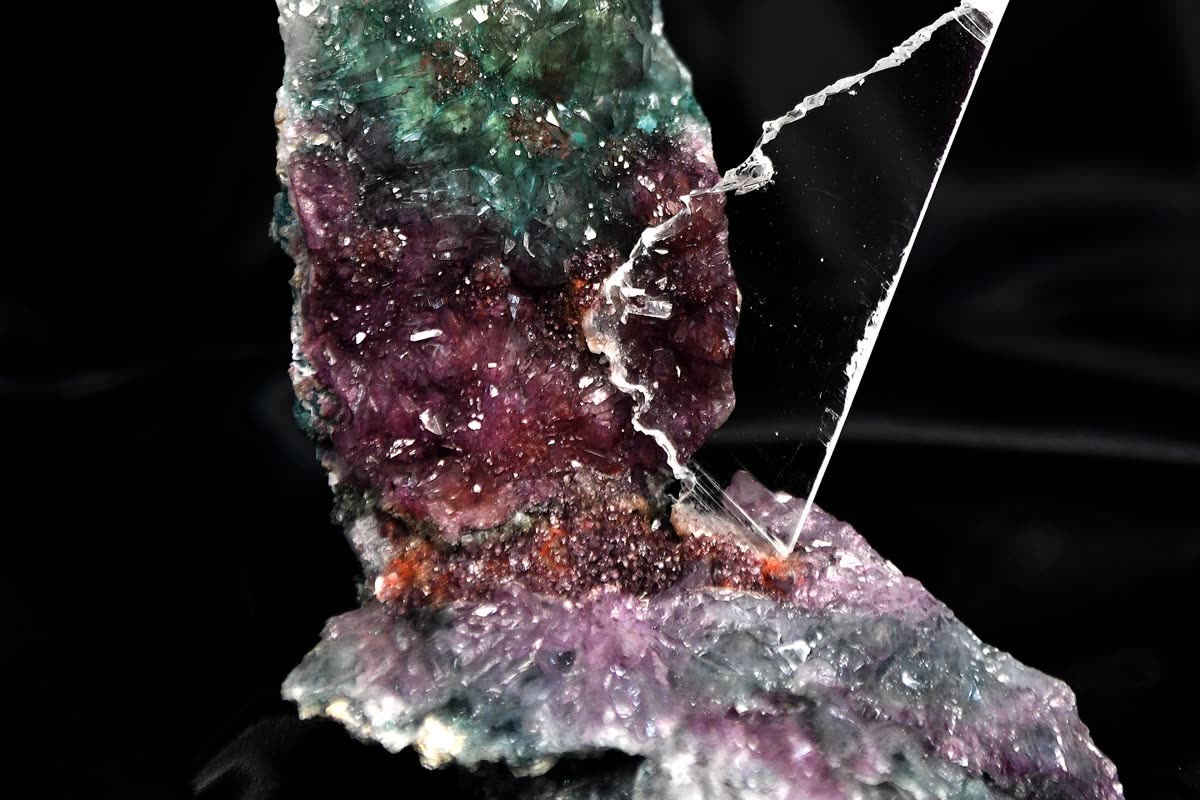
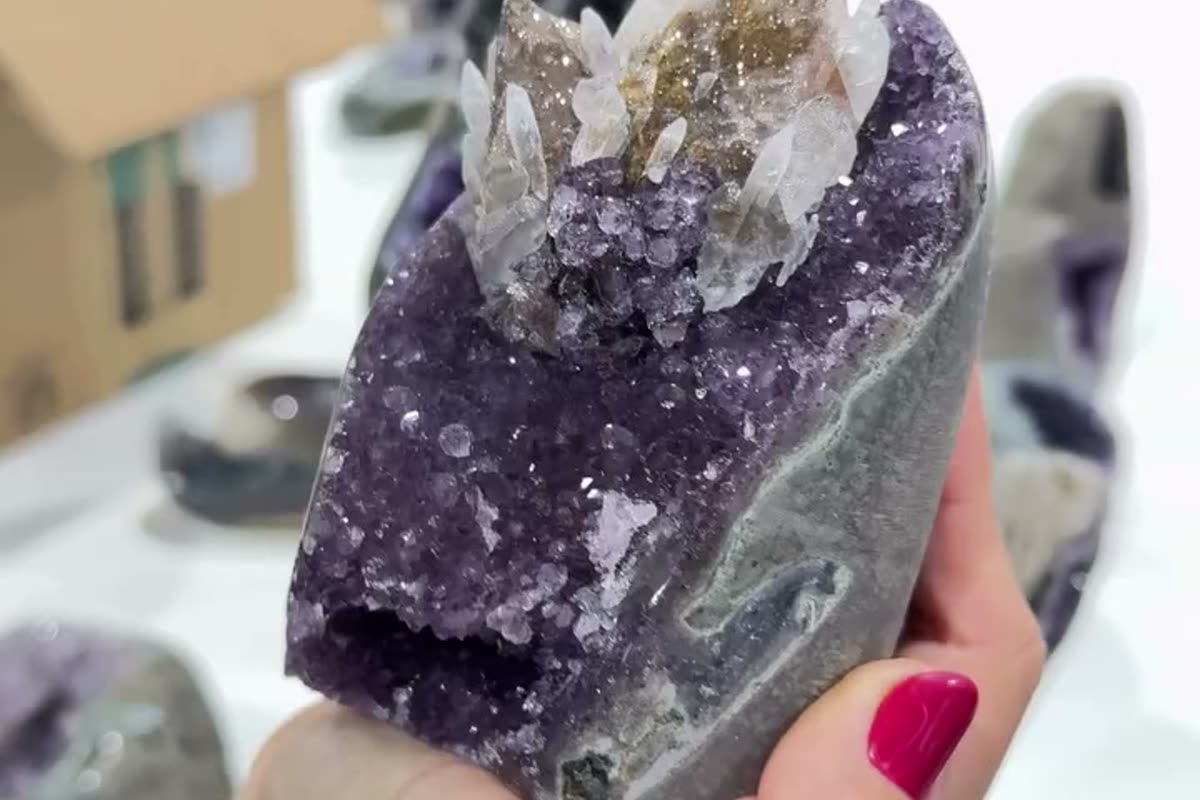
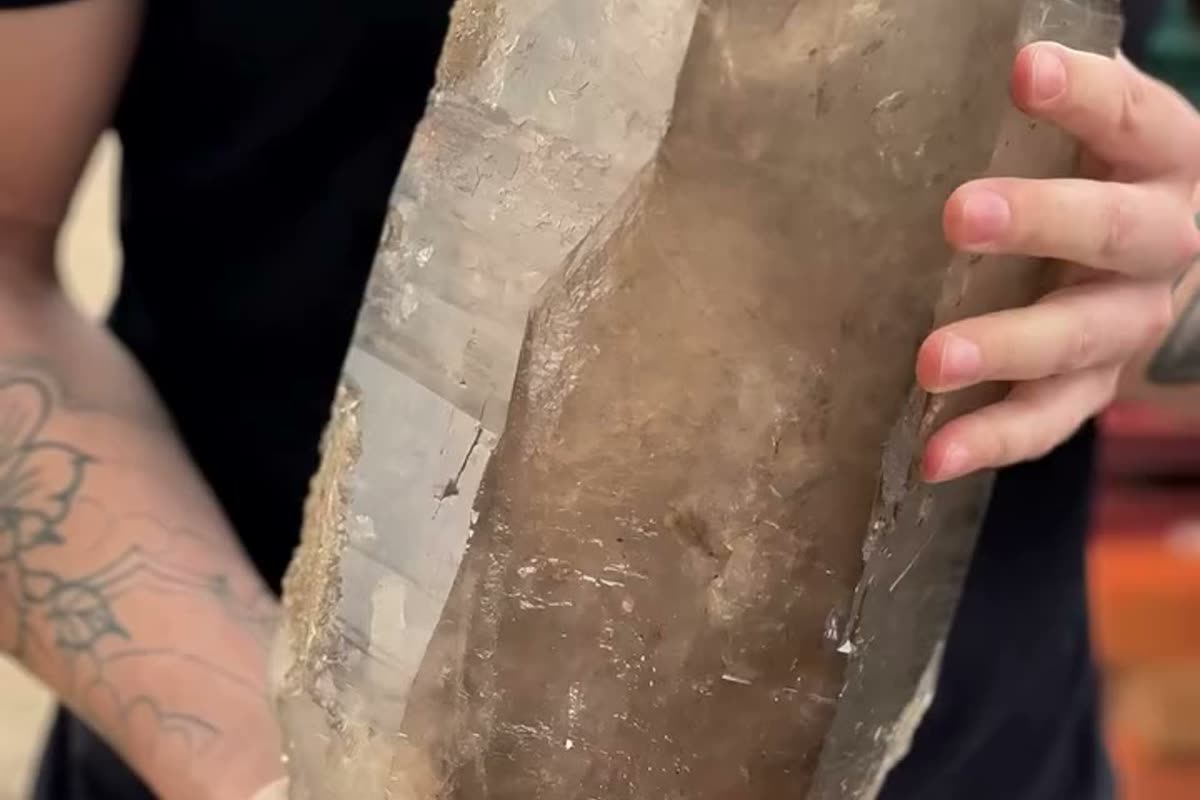
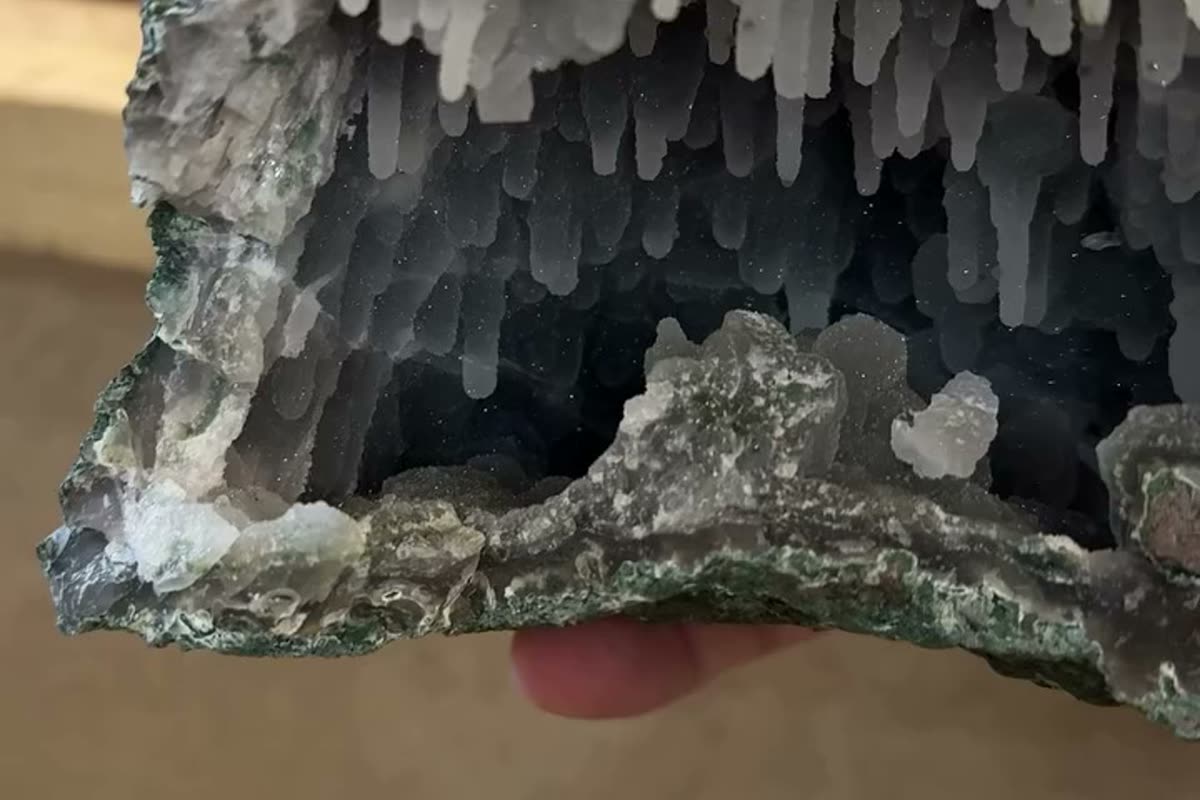
Three families, one origin. Amethyst geode, smoky quartz point and a chalcedony stalactite: pegmatite, vein and basalt-cavity material, all Brazilian. Photos: CS Minerals
Amethyst
The category most associated with Brazil. It arrives in several commercial formats: geode halves, standing cathedrals, clusters, druze plates, polished points and towers, and small tumbled or chipped material for retail bins. Color runs from pale lilac to deep purple, and saturation is usually stronger in smaller, tighter cavities than in very large ones. Size and color grade drive price far more than weight alone.
Quartz
The workhorse of any crystal inventory, because it spans every price tier. Clear quartz points and clusters serve entry and mid-price retail. Rose and smoky quartz carry well as polished goods. Rutilated quartz, with golden needle inclusions of rutile, commands a premium. It also photographs extremely well, which matters for online and live sellers.
Tourmaline
Pegmatite material, usually the highest per-gram value in a mixed order. It sells as specimen crystals, as polished slices, and as rough or preforms for jewelry makers. This is the category where origin information and clear treatment disclosure matter most, because the value per gram is high enough to justify the diligence.
Crystal clusters
Multi-point specimens on a shared matrix. Overall size, point integrity and matrix quality set the price. So does something first-time buyers often overlook: whether the piece stands on its own. Always ask whether a cluster is self-standing or requires a base or mount, because that affects both display and freight.
Decorative stones
Worked ornamental goods: spheres, towers, bowls, bookends, coasters, slabs, candle holders and lamp bases. This is the most repeatable part of a crystal catalog. Workshops cut these pieces to specification rather than finding them. As a result, you can reorder them in consistent sizes, which makes them the backbone of a replenishment program.
Unique statement pieces
Single large items (tall cathedrals, oversized towers, sculptural specimens) typically ranging from about 20 kilograms to several hundred. Suppliers sell them as individual units, each with its own photographs, weight and dimensions. They are not reorderable: once a specific piece sells, it is gone. For retailers they function as window and destination pieces; for designers they are project specifications.
Jewelry and craft stones
Rough and preforms, cabochons, beads, chips and small points for wire wrapping and silversmithing. Suppliers almost always price them by weight rather than by piece. They are also the lowest-friction category for a first order, because weight-based lots are easy to specify and compare. CS Minerals also produces finished jewelry from its own material, hence the “& jewelry” in the company name. That matters if you buy both loose stone and finished pieces.
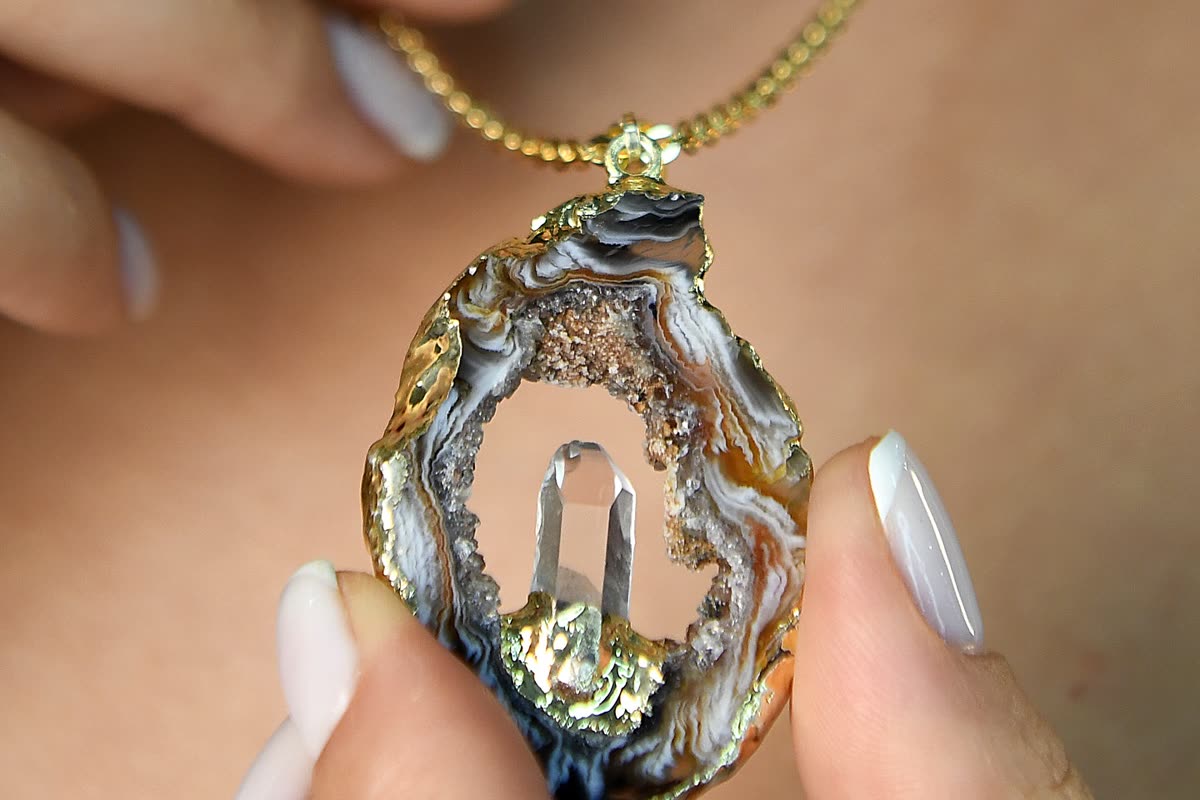
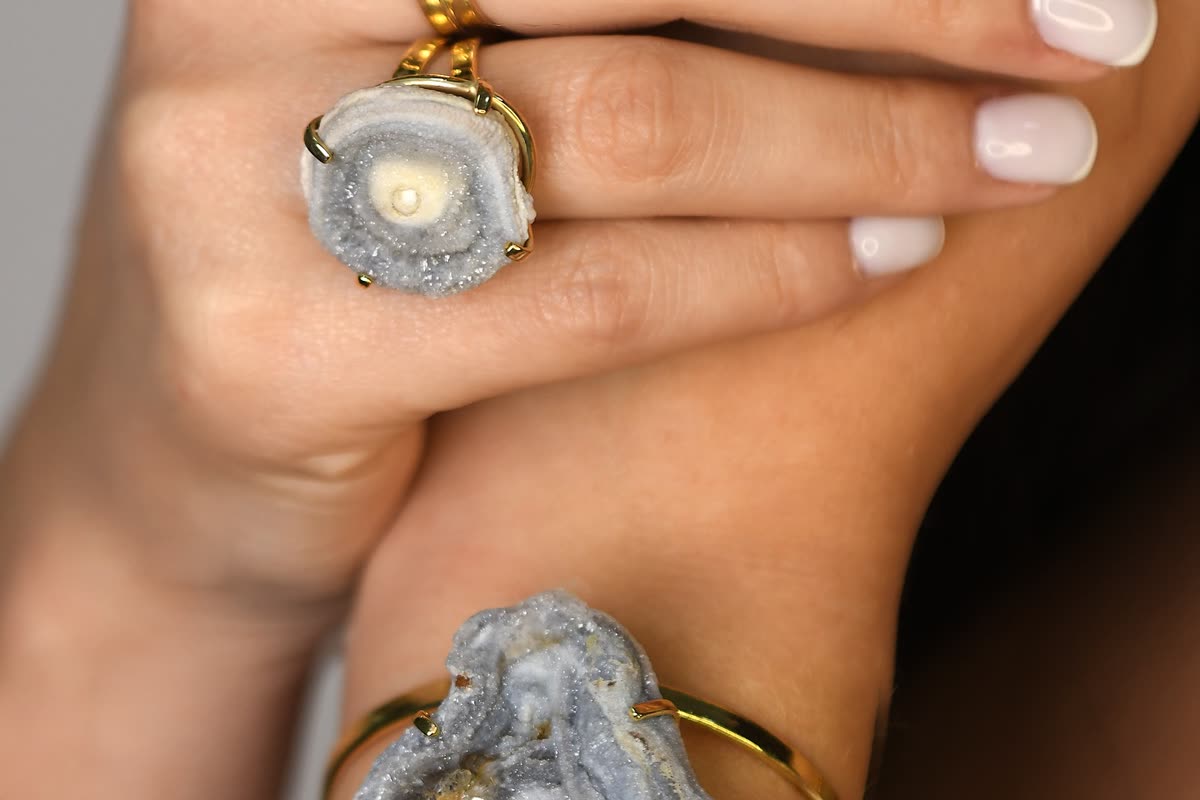
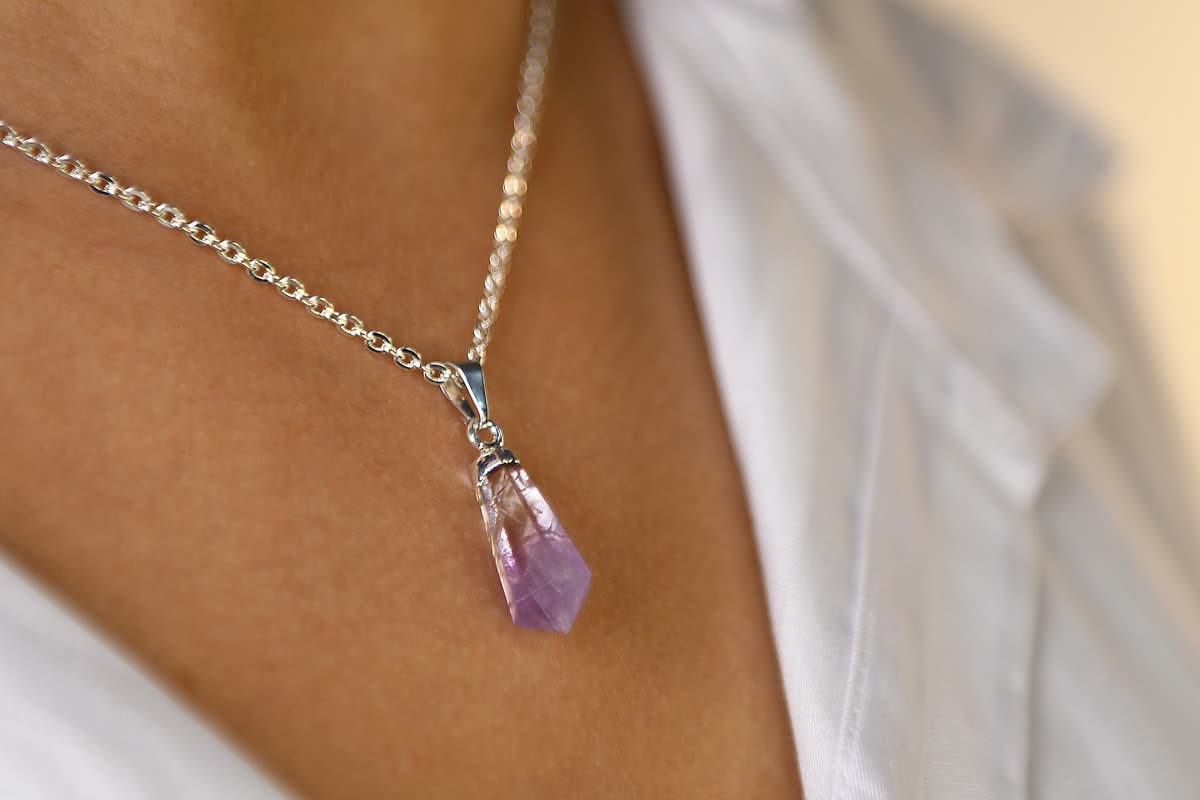
Finished pieces from Brazilian stone. Agate slice, chalcedony rosette and amethyst, set in gold and silver. Hands in frame give the scale reference that a plain product shot cannot. Photos: CS Minerals
Who Usually Buys From a Brazilian Crystal Supplier?
- Metaphysical stores order broad assortments across price tiers, plus one or two display pieces, and they care most about product mix and reliable replenishment.
- Crystal shops buy clusters, towers, polished goods and retail-sized material, so consistency between reorders matters most.
- Gift shops want low and mid-ticket polished pieces and packaged goods, and they judge them on unit price and sell-through speed.
- Jewelry stores order finished stones, cabochons and select specimens, and they look first at quality grading and treatment disclosure.
- Jewelry makers and lapidaries buy rough and preforms by weight, because yield per kilogram and material integrity decide their margin.
- Product and jewelry designers need specific material in repeatable dimensions, especially availability for a full production run.
- Interior designers and architects buy large statement pieces, slabs and sculptural specimens, and they need exact dimensions, weight, photography and delivery certainty.
- Online sellers want photogenic mid-ticket pieces with workable margins, backed by real photography of the actual unit.
- Live sellers buy mixed lots and graded assortments for on-air selling, so volume, variety and restock cadence come first.
- Collectors and specimen dealers buy individual high-grade specimens, and locality information and specimen condition matter most to them.
How Buying From a Brazilian Crystal Supplier Works
A direct order from Brazil follows roughly the same seven steps every time. Understanding them in advance is what separates a smooth first order from an expensive lesson.
Choosing products with a Brazilian crystal supplier
Selection happens in three ways: from a catalog of repeatable SKUs, from photos and video of specific units, or live. In a live broadcast, the supplier handles each piece on camera and buyers claim units in real time. For unique pieces, the only meaningful selection is unit-level: a photograph of “an amethyst cathedral” is not a photograph of your amethyst cathedral. Ask for images of the exact piece you are reserving, with a scale reference in frame.
MOQ at a Brazilian crystal supplier
MOQ means Minimum Order Quantity, the smallest order a supplier will accept. It exists because the fixed costs of a wholesale order (handling, packing, export documentation, freight consolidation) do not scale down. Suppliers express MOQ in one of three ways, and the difference is significant:
- By order value: a minimum dollar amount per order
- By weight: a minimum number of kilograms, common for rough and bulk material
- By piece count: a minimum number of units per SKU
Always ask which one applies, and whether it applies per SKU or per total order. A “50-piece minimum” per SKU and a “50-piece minimum” per order are completely different commitments.
How a Brazilian crystal supplier prices
Suppliers normally price bulk and rough material per kilogram, unique pieces per unit and mixed assortments per lot. But the number that actually determines your cost is not the unit price: it is the commercial term attached to it. Ask explicitly which term the quote uses. FOB Brazil means you arrange and pay for freight from the Brazilian port onward. CIF means the supplier covers freight and insurance to the US port, but not duties or inland delivery. DDP means delivered duty paid to your address. Two quotes that look 20% apart on unit price can easily invert once you normalize the terms.
How a Brazilian crystal supplier should pack
Crystals are simultaneously brittle and heavy, and that combination is what breaks shipments. Competent packing means individual wrapping, foam or bubble isolation between pieces and double-boxing for mid-size items. Large cathedrals and slabs need custom wooden crates with internal bracing. For anything palletized, ask how the supplier secures the load against shifting. Then ask the two commercial questions: is packing included in the price or billed separately, and who absorbs the cost of breakage in transit?

International shipping
There are two realistic modes, and the ratio of value to weight dictates the choice:
- Air freight, days rather than weeks, priced on chargeable weight. It makes sense for high-value, low-weight material: tourmaline, fine specimens, jewelry rough, and any order that has to land before a specific date.
- Ocean freight, weeks rather than days, priced by volume or container. It is the only economically sensible option for tonnage: geodes, slabs, large decorative pieces. Orders that do not fill a container ship LCL (less than container load, consolidated with other shippers); larger programs move FCL (full container load).
A frequent first-order mistake is choosing ocean freight for the cost saving. The saving then turns out smaller than expected once LCL consolidation fees, port charges and inland trucking come in. Ask for the all-in landed estimate, not the ocean rate.
Customs
In a US import, the importer of record is responsible for correctly classifying the goods and paying any duties owed. Crystals and stones do not have one single tariff line. Classification depends on how worked the material is: unworked, simply sawn, or finished into articles. The applicable rate follows that classification, not the product’s marketing name. Mineral specimens acquired for collections can fall under a different heading again.
Two practical cautions. First, duty treatment on Brazilian-origin goods has changed more than once in recent years. So verify the current rate for your specific tariff line when you order, rather than relying on an older figure. Second, for a recurring import, request a binding ruling so customs settles the classification before volume builds. Verify current classifications in the USITC Harmonized Tariff Schedule and current procedures with US Customs and Border Protection, and work with a licensed customs broker on the first shipment.
Delivery
The final leg is port or airport arrival, broker clearance, and inland trucking to your address. Large statement pieces add two considerations that are easy to forget at the point of order. Can the delivery site receive a pallet, and can anyone on site safely move a 200-kilogram crate? Build the timeline backwards from when you actually need the goods. Also, never schedule a store opening, a trade show or a live event against an ocean shipment without a buffer.
What to Look for in a Brazilian Crystal Supplier
- Origin: a good supplier can name the region or district a lot came from, whereas a warning sign is a vague “sourced in Brazil” with no further detail.
- Quality: it explains its own grading language and applies it consistently, while a weak one describes everything as “AAA” or “premium”.
- Consistency: a reorder looks like the first order; however, quality that drifts once you are a recurring customer is a warning sign.
- Packing: it describes materials and method before you ask, but treating packing as an afterthought is a red flag.
- Communication: it works in English, in your business hours, with named contacts, whereas days of silence mid-order signal trouble.
- Logistics: it handles export documentation routinely and quotes on clear terms, while “you figure out the shipping” is a warning sign.
- Real photos: it shows images of the actual unit, unfiltered and with a scale reference, rather than stock imagery or heavily edited color.
- Video: it sends video of the piece turning under normal light instead of one flattering still image.
- Range: it can serve several price tiers from a single order, whereas a weak supplier offers only one category or one price point.
- Track record: it has a verifiable commercial history and contactable references, but no traceable history at all is a warning sign.
- After-sale support: it states a policy for breakage, shortages and misdescription, whereas a weak supplier’s responsibility ends at the Brazilian port.
One test cuts through most of the list. Ask for a short daylight video of one specific piece, with something of known size next to it. Suppliers who work with real inventory produce it within a day. It is a small request that reveals a great deal.
A Brazilian Crystal Supplier vs a US Distributor
- Variety: buying direct from Brazil shows you the broad range at origin, including material that never reaches the US market, whereas a distributor offers only what it chose to import.
- Access to origin: direct buyers can request specific regions, formats and grades, while a distributor made its selection for you months earlier.
- MOQ: suppliers size a direct order around an international shipment, but a distributor can often sell by the box or the piece.
- Logistics: on a direct order you (or the supplier under DDP) manage freight, clearance and inland delivery, whereas a distributor ships domestically with no customs involvement.
- Exclusivity: direct buying gives you unique pieces and lots your local competitors do not have, while a distributor offers the same catalog to every other retailer.
- Price: direct is lower at the unit level, although landed cost depends on freight and duties; a distributor charges more per unit but leaves no import cost or risk to absorb.
- Lead time: direct takes weeks (days by air, considerably longer by ocean), whereas a distributor delivers in days.
- Working capital: a direct order commits more capital for longer, while a distributor lets you order against actual demand.
- Customs responsibility: on a direct order it is yours as importer of record unless the term is DDP, but a distributor leaves you none.
This is not a decision most established retailers make once. The common pattern is to run both channels deliberately. A domestic distributor handles fast replenishment of proven SKUs. Direct import, meanwhile, covers statement pieces, differentiated assortments and the margin of buying at origin. The direct channel is where differentiation and margin live; the domestic channel is where speed lives.
How CS Minerals Works as a Brazilian Crystal Supplier for US Buyers
CS Minerals is a Brazilian supplier of crystals, minerals and natural stones working with wholesale and professional buyers in the United States. We built the operation around four things:
- Brazilian sourcing. We source material at origin across Brazilian producing regions, which is what makes it possible to offer both repeatable polished goods and one-of-a-kind statement pieces from the same supplier.
- Curation. We select lots rather than simply aggregate them, so an order arrives as a usable assortment across price tiers instead of an undifferentiated mass of material.
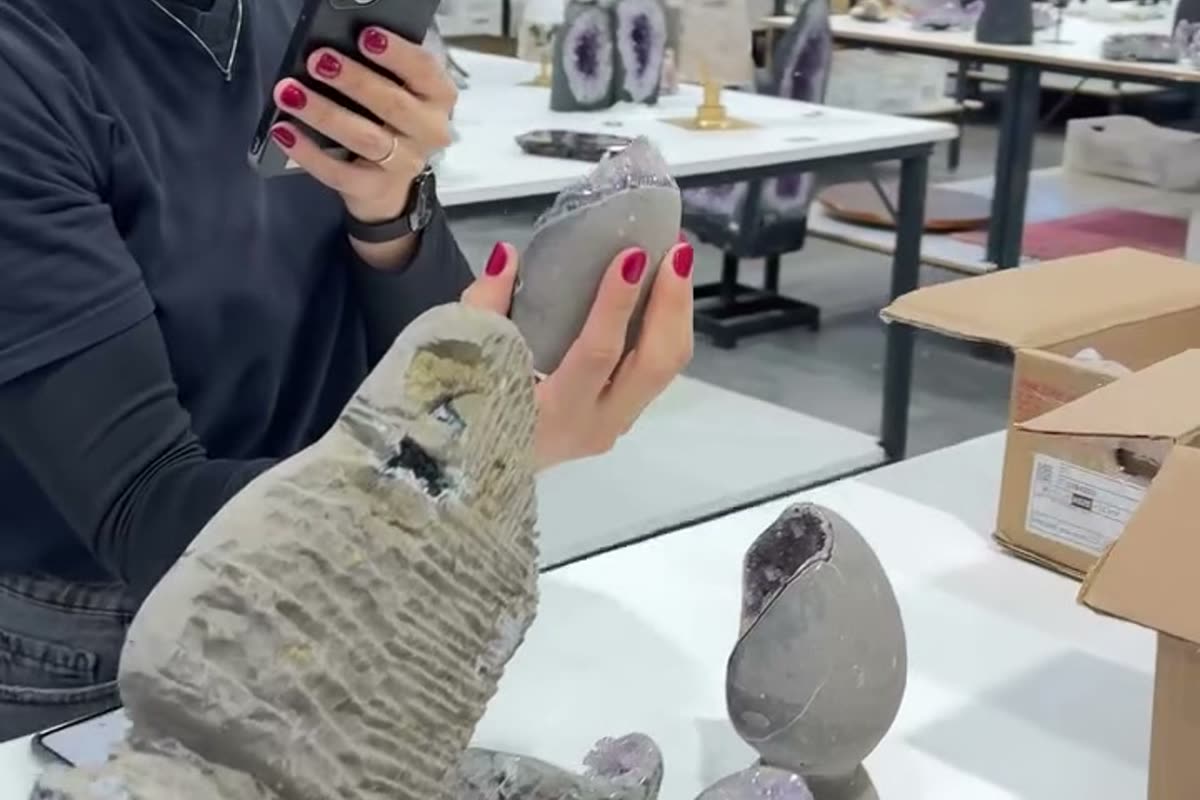
- Live selling. Buyers can see pieces handled on camera, compare sizes and color in real time, ask questions during the broadcast and claim specific units. For unique pieces, this resolves the core problem of buying remotely: you are looking at the actual unit, not a representative photograph.
- International logistics and support. We pack orders for international transit and ship them to buyers in the United States, with a named commercial contact through the order rather than a generic inbox.
Live sales from the warehouse
Live sales scheduleCS Minerals runs live sales Monday to Friday, 8am to midnight Brazilian time, on Instagram at @csminerals. Brazil is generally one to five hours ahead of the continental United States depending on the season, so the window overlaps the US morning: worth knowing if you plan to buy on air.
We set commercial terms (minimum order, payment terms, shipping mode and lead time) by buyer profile. After all, a jewelry maker buying rough by weight and a designer specifying one 300-kilogram cathedral place very different orders.
Related reading: Wholesale Crystals for Metaphysical Stores, How to Buy Crystals Wholesale for Your Retail Business, Brazilian Amethyst Wholesale and Natural Stones for Architects and Designers.
Brazilian Crystal Supplier: Frequently Asked Questions
Can US retailers buy crystals directly from Brazil?
Yes. US retailers buy directly from Brazilian suppliers as a normal commercial practice. The retailer selects the material, the supplier packs and ships it by air or ocean freight, and the goods then clear US customs. The US buyer is the importer of record. Under DDP terms, however, the supplier handles duties and delivery.
What crystals are commonly exported from Brazil?
The most commonly exported categories are amethyst (clusters, geodes, cathedrals and polished pieces) and quartz in its several varieties (clear, smoky, rose and rutilated). Brazil also exports agate, tourmaline, beryls such as aquamarine and emerald, and topaz. Ornamental stone worked into spheres, towers, bowls, bookends and slabs completes the list.
What is the minimum order for wholesale crystals?
There is no single industry minimum. Suppliers set MOQ by order value, by weight or by piece count, and the figure depends on the category. Rough and bulk material usually carry weight-based minimums, while suppliers often sell unique statement pieces as single units. Ask any supplier which basis they use and whether it applies per SKU or per total order.
How are crystals shipped from Brazil to the USA?
By air freight or ocean freight. Air freight takes days, and carriers bill it by chargeable weight. It suits high-value, low-weight material and time-sensitive orders. Ocean freight takes weeks, and carriers bill it by volume or container. It is the practical option for heavy material such as geodes and slabs. Smaller ocean orders travel LCL, consolidated with other shippers.
Are Brazilian crystals good for resale?
Retailers widely resell Brazilian material, largely because the range covers every price tier from inexpensive tumbled stones to individual display pieces. That range is what makes it workable for a retail assortment. The same supplier can provide both the volume products that drive traffic and the statement pieces that define a store.
How can I verify the quality of wholesale crystals?
Ask for unedited photographs and video of the specific units, filmed in ordinary daylight with a scale reference in frame. Ask the supplier to state its grading criteria explicitly and to disclose any treatment. Heat-treated citrine, for example, is common and legitimate, but sellers must declare it. For a first order, request a smaller trial shipment and compare the goods received against the images and descriptions before committing to volume.
Does CS Minerals sell wholesale to US retailers?
Yes. CS Minerals supplies wholesale and professional buyers in the United States, including retail stores, online and live sellers, jewelry makers, designers and collectors. Wholesale access, catalog and commercial terms are available on request through the wholesale program page.
Request Wholesale Access
Looking for Brazilian crystals for your store, studio or project? Request wholesale access to CS Minerals to receive current availability, pricing and shipping options for the United States.
About CS Minerals
CS Minerals is a Brazilian supplier of crystals, minerals and natural stones serving wholesale buyers, retailers and professional buyers in the United States. The company combines Brazilian sourcing, product curation, live selling and international logistics to connect buyers with Brazilian stones and minerals.
Written by the CS Minerals Wholesale Team ·
Last updated
Photographs: CS Minerals, via @csminerals.
This article is general commercial information, not customs, tax or legal advice. Confirm current tariff classifications and import requirements with a licensed customs broker before importing.
Comments
7 responses to “Brazilian Crystal Wholesale Supplier: How to Buy Directly From Brazil”
[…] wholesale access for current availability, or read Brazilian Crystal Wholesale Supplier for how a direct order from Brazil actually […]
[…] and statement pieces without flying to a trade show. Background on the sourcing side is in our guide to buying directly from Brazil, and the geology behind the Brazilian core is covered in what crystals are found in […]
[…] reading: Brazilian Crystal Wholesale Supplier, Where to Source Brazilian Stones at Origin and our step-by-step wholesale buying […]
[…] apply the scorecard above to us the same way you would to anyone else. Related reading: Brazilian Crystal Wholesale Supplier, How to Buy Crystals Wholesale and What Is the Best Website to Buy […]
[…] Brazilian Crystal Wholesale Supplier: The Complete Guide […]
[…] Brazilian Crystal Wholesale Supplier: The Complete Guide […]
[…] reading: Brazilian Crystal Wholesale Supplier: How to Buy Directly From Brazil, How to Buy Crystals Wholesale and What Crystals Are Commonly Found in […]