
Quick answer: The best website to buy crystals depends first on whether you are buying one piece for yourself or buying inventory to resell. General marketplaces and retail crystal shops serve retail buyers; wholesale buyers need a supplier’s own B2B site, a wholesale marketplace, or a live selling channel, because retail sites cannot give you resale margin.
Beyond that, no website is inherently trustworthy. Instead, what distinguishes a good crystal site is specific and checkable in about ten minutes: photographs of the actual unit rather than stock images, a scale reference in frame, stated dimensions and weight, explicit treatment disclosure, a real shipping and breakage policy, and named company details. This article therefore gives you the checklist, the photo red flags, and the list of glass and dyed materials routinely sold online as natural stone.
First: Do You Want a Website to Buy Crystals Retail or Wholesale?
This decides everything else, and buyers frequently get it wrong: ordering inventory from retail sites and then finding there is no margin left to resell on.
| Retail buying | Wholesale buying | |
|---|---|---|
| You want | One piece, now | Inventory you can resell at a margin |
| Right platforms | Retail crystal shops, general marketplaces | Supplier B2B sites, wholesale marketplaces, live selling |
| Price basis | Per piece, retail | Per piece, per kilogram or per lot, at wholesale |
| Documentation needed | None | Usually a resale certificate or equivalent |
| Minimum | One item | An MOQ by value, weight or piece count |
The Four Types of Website Where You Can Buy Crystals
1. A supplier’s own B2B site
The supplier’s own catalog, with wholesale pricing behind an approved account. It also offers the best prices and, at origin suppliers, access to material that never reaches marketplaces. However, it requires an application and usually a resale certificate. Most of these sites show availability rather than a fixed public price list, because you cannot catalogue unique pieces like SKUs.
2. Wholesale marketplaces
Platforms aggregating many suppliers behind one account and one checkout. They offer the lowest friction for a first wholesale order and also include buyer protection. The structural weakness, however, is that the inventory is, by design, visible to every other buyer: useful for testing a category, weak as the foundation of a differentiated store.
3. General marketplaces
Broad consumer platforms where individual sellers list crystals. Enormous selection and highly variable reliability, because the platform is not the seller. As a result, quality control, treatment disclosure and accurate sizing depend entirely on the individual listing. They are fine for retail purchases, but rarely priced for resale.
4. Live commerce platforms
Broadcast selling where the seller handles each piece on camera and buyers claim units in real time. This is the strongest online format for one-of-a-kind material, because you watch the actual stone turn under light at a known scale. However, it is the weakest format for precise replenishment, because you buy what is on the table that day.
How to Check a Website in Ten Minutes Before You Buy Crystals
Run this list on any site before you spend money. In short, failing three or more is a reason to leave.
- Are the photographs of the actual unit? For unique pieces, one listing must equal one stone. If the same photo appears across multiple listings, you are buying a category, not an item.
- Is there a scale reference in frame? For instance, a hand, a coin or a ruler. Size is the most commonly misjudged variable in online crystal buying.
- Are dimensions and weight stated numerically? “Large” is not a dimension.
- Is there video? After all, colour and internal structure do not survive a single still image. Video in ordinary light is the honest format.
- Is treatment disclosed? Look for explicit statements about heating, dyeing, irradiation or coating. Silence on this is also a finding.
- Is origin stated? A region or district, not just a country.
- Is there a written breakage and shortage policy? In this category, you will eventually use that policy.
- Are shipping costs and timelines shown before checkout? Heavy goods hide their cost in shipping.
- Are there real company details? Legal name, address, a way to reach a person. Exporters must issue commercial invoices, so a legitimate wholesale supplier has all of this.
- Are returns possible at all? Many wholesale suppliers do not accept returns on unique pieces, which is reasonable, but it must be stated, not discovered.
Photo Red Flags
- Colour that cannot exist in the species. Neon-purple amethyst and electric-blue quartz are editing, not geology.
- Pure black or pure white backgrounds with hard rim lighting. Beautiful, but it hides fractures and colour zoning.
- Wet-look surfaces. Sellers often photograph stone wet because water deepens colour and conceals dull, unpolished surfaces. However, what arrives is dry.
- Single angle only. Every specimen has a good side, so one photograph shows you only the good side.
- No base of the piece shown. For towers and cathedrals this is where cutting quality and stability are visible, and where sellers hide problems.
- Backlighting on everything. Light behind a stone makes almost any quartz look clear and saturated.
What “Genuine” Means When You Buy Crystals on a Website
A significant share of material sold online as crystal is glass, or is natural stone altered so heavily that the colour you are buying is not the colour it formed with. None of this is illegal, and some of it is completely standard trade practice. In the United States, the FTC Guides for the Jewelry Industry treat failing to disclose certain gemstone treatments as deceptive. The problem is non-disclosure, and if you resell an undisclosed treated stone as natural, the complaint arrives at your counter, not the supplier’s.
| Sold as | What it usually is | How to handle it |
|---|---|---|
| “K9 crystal”, “crystal blanks”, “crystal glass” | Optical glass, not mineral at all | Not a natural stone. Legitimate as glass; misleading as “crystal” |
| “Cherry quartz” | Glass with inclusions | Manufactured material |
| “Opalite” | Manufactured opalescent glass | Manufactured material |
| “Goldstone” | Glass with copper flecks | Manufactured material |
| “Blue obsidian”, “green obsidian” | Usually glass slag | Natural obsidian is black, brown or mahogany-toned |
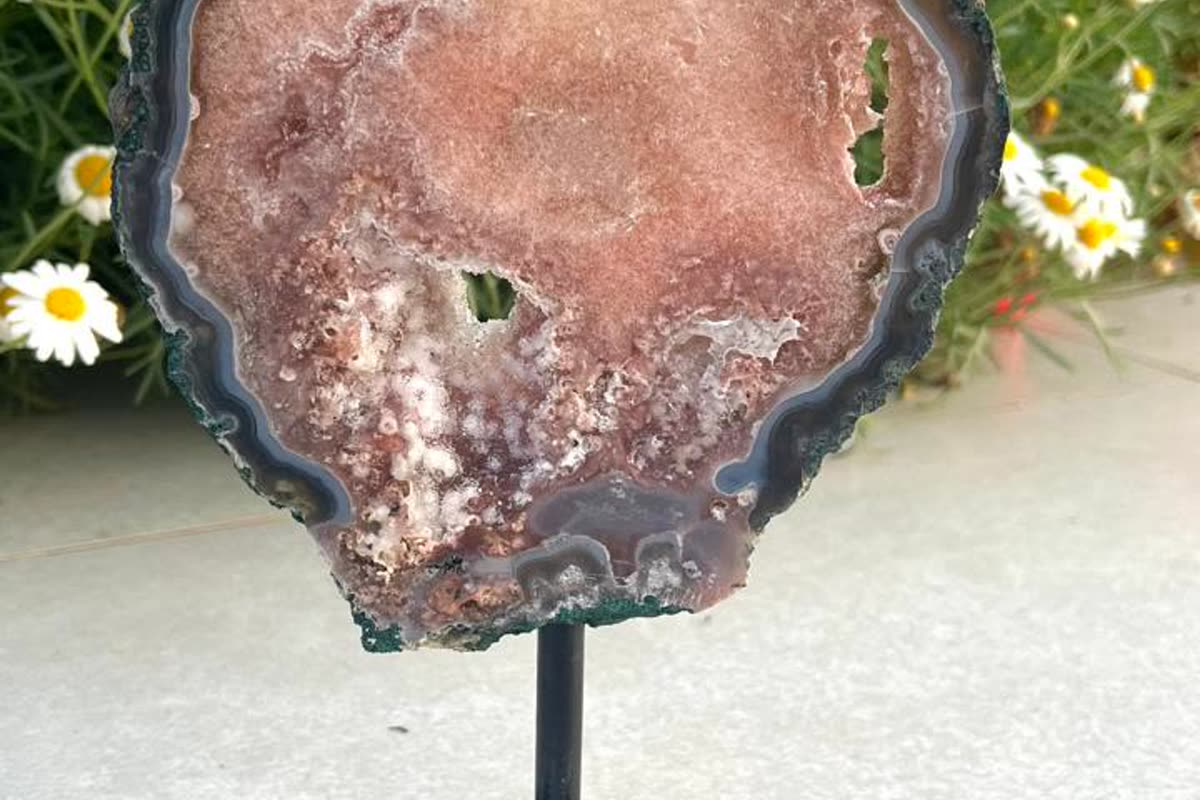
| Bright dyed agate slices and geodes | Natural agate, dyed | Standard practice: sellers must disclose it as dyed |
| Aura, titanium or angel aura quartz | Natural quartz with a vapour-deposited metal coating | Standard practice: sellers must disclose it as coated |
| Most commercial citrine | Amethyst, heat-treated to shift colour | Long-standing, accepted practice: sellers must disclose it as treated |
| Very dark smoky quartz at low prices | Often irradiated quartz | Disclosure expected |
The practical rule: ask every supplier, in writing, whether a lot is natural, treated or manufactured, and keep the answer. A supplier who answers plainly is protecting you. One who is vague, on the other hand, has moved the risk onto you.
Payment and Protection When You Buy Crystals From a Website
- Marketplaces carry platform dispute resolution. That is their main value on a first purchase.
- Direct wholesale orders normally run on invoice with bank transfer, which has no chargeback. Protection comes from documentation instead: a written specification, the commercial invoice, photographs of the crate before unpacking, and a stated breakage policy.
- Never treat “certificate of authenticity” as protection. There is no general certification scheme for decorative mineral specimens; a certificate issued by the seller is a document the seller wrote. In contrast, independent laboratory reports exist for cut gemstones and do carry weight.
How CS Minerals Sells Online
CS Minerals sells to wholesale and professional buyers in the United States through two of the four channels above: direct wholesale orders from Brazil, and live selling, where pieces are handled on camera so buyers can judge size and colour before claiming a specific unit.
For one-of-a-kind material that combination exists for a reason: a photograph of “an amethyst cathedral” is not a photograph of the cathedral you are buying, and live handling is the closest remote equivalent to picking it up. We provide availability and pricing on request rather than as a fixed public list, because nobody can catalogue unique pieces as repeatable SKUs.
Related reading: Who Are the Best Wholesale Crystal Suppliers?, Where Can I Buy Crystals Wholesale? and How to Sell Crystals Online.
What the Best Website to Buy Crystals Does After the Sale
Most evaluations stop at checkout, which is where the real differences start. A website is easy to judge on photographs and hard to judge on what happens when a box arrives broken.
Before a first order, find the answers to four questions. A supplier who makes them hard to find has told you something:
- Breakage policy. Who absorbs a cracked geode, and is the answer written down or decided case by case?
- Reorder consistency. If you sell through, can you get the same grade again, or was that lot a one time buy?
- Response time. How long does a question take to answer before you are a customer? It rarely improves afterwards.
- Who you are actually talking to. A person who can check the warehouse, or a chat agent reading from a script.
Testing a Website With a Small Order Before You Buy Crystals in Volume
The cheapest research you can do is a small first order placed with no intention of scaling immediately. It buys information that no amount of site evaluation produces, especially about packing and disclosure.
Watch three things when the box arrives. Whether what you received matches what the photographs implied, how the supplier packed it for the weight and fragility involved, and whether the invoice states treatment and origin without you having asked. Each one also predicts what a large order will look like.
A supplier who handles a small order carefully is worth more than a cheaper one who handles it casually, because the difference compounds across every reorder you place afterwards.
Best Website to Buy Crystals: Frequently Asked Questions
Where should I shop for crystals online?
For a single piece at retail, a specialist crystal shop or a general marketplace listing with real photographs and a scale reference. For inventory to resell, a supplier’s own B2B site, a wholesale marketplace or a live selling channel: retail sites are not priced to leave you resale margin. Judge any site on actual-unit photography, stated dimensions, treatment disclosure and a written breakage policy.
How can I tell if a crystal website is trustworthy?
Check whether photographs show the actual unit with a scale reference, whether it gives dimensions and weight numerically, whether it explicitly discloses treatments, whether shipping cost and breakage policy appear before checkout, and whether the company publishes its legal name and address. Failing three or more of these is reason enough to buy elsewhere.
Are cheap crystals online fake?
Not necessarily: common species such as clear quartz and amethyst are genuinely abundant and inexpensive. But some low-cost material is glass rather than mineral, including K9 “crystal”, cherry quartz, opalite, goldstone and most blue or green “obsidian”. Other material is natural stone that has been dyed, coated or heat-treated. All of that is legitimate when disclosed; the problem is when it is not.
Can I buy crystals wholesale online without a business?
Most wholesale suppliers require business documentation (commonly a resale certificate) before opening an account, because that documentation is what permits a tax-exempt wholesale purchase. Requirements vary by supplier and by state.
Is it safe to buy large crystals online without seeing them?
It is routine, provided you insist on the right evidence: video of that specific unit in ordinary daylight, a scale reference, stated dimensions and weight, a photograph of the base, and a written description of how the piece will be crated. For heavy pieces also confirm that your delivery site can receive a pallet.
Does CS Minerals have an online wholesale catalog?
CS Minerals provides availability and pricing for wholesale buyers on request through the wholesale program, and also shows pieces live so buyers can judge them before claiming a unit.
What should a crystal website tell me before I order?
Species, origin, dimensions, weight and treatment status, in writing, without you having to ask. A site that shows only a photograph and a price is asking you to accept a description it has not made. For wholesale, add the minimum order and who absorbs breakage in transit.
Request Wholesale Access
Buying Brazilian crystals for resale? Request wholesale access to CS Minerals for current availability, pricing and shipping options to the United States.
About CS Minerals
CS Minerals is a Brazilian supplier of crystals, minerals and natural stones serving wholesale buyers, retailers and professional buyers in the United States. The company combines Brazilian sourcing, product curation, live selling and international logistics to connect buyers with Brazilian stones and minerals.
Written by the CS Minerals Wholesale Team · Last updated
General commercial information. Material names and treatment practices vary between suppliers: always confirm treatment status in writing for your own lots.
Comments
2 responses to “What Is the Best Website to Buy Crystals?”
[…] Related reading: Who Can I Sell Crystals To?, How to Price Crystals to Sell and What Is the Best Website to Buy Crystals? […]
[…] So apply the scorecard above to us the same way you would to anyone else. Related reading: Brazilian Crystal Wholesale Supplier, How to Buy Crystals Wholesale and What Is the Best Website to Buy Crystals? […]