
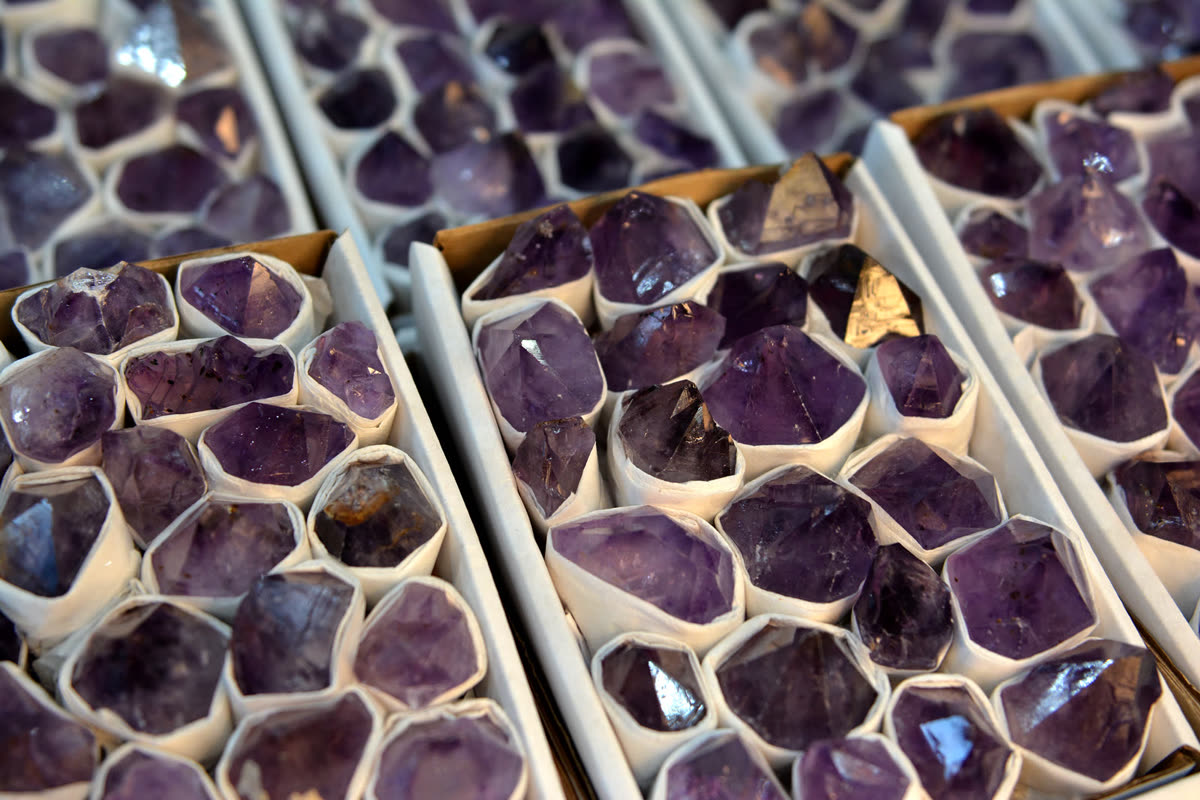
Quick answer: You can buy Brazilian crystals wholesale through five practical channels: directly from a Brazilian supplier or exporter, from a US importer or distributor, in person at a gem and mineral trade show, through live selling broadcasts, or on a wholesale marketplace. Each one trades a different thing away.
Direct from Brazil gives you the widest selection and origin-level pricing, but requires freight and customs handling. In contrast, a US distributor gives you speed and small minimums at a higher unit cost. Trade shows let you inspect goods by hand once or twice a year. Live selling lets you claim specific one-of-a-kind pieces remotely. Finally, marketplaces are the easiest to start on and the hardest to differentiate with. This article therefore compares all five and matches each to a buyer profile.
The Five Ways to Buy Brazilian Crystals Wholesale
1. Buy Brazilian crystals wholesale direct from a supplier or exporter
You place the order with a company located in Brazil. It selects and packs the material, handles export documentation, and ships to you by air or ocean freight. You act as importer of record in the United States unless the quote is on DDP terms.
This is the channel with the widest selection, because you are buying from the point in the chain where the material is still ungraded and unfiltered by someone else’s guess about what the US market wants. It is also the channel where one-of-a-kind pieces are still available: large cathedrals and sculptural specimens are usually claimed before they ever reach a distributor’s catalog.
What it costs you: freight timelines, a customs process, and a larger commitment per order. Suppliers size the minimum around an international shipment rather than a box.
2. From a US importer or distributor
A company that already imported Brazilian material and warehouses it domestically. You order in dollars, it ships domestically, and no customs process touches you.
This is the fastest and lowest-risk way to buy Brazilian material, and for replenishing proven, fast-moving SKUs it is often the correct answer. The limitation, however, is structural: you are choosing from a selection someone else made months earlier, at a price that includes their import cost and their margin. As a result, every other retailer buying from that distributor sees the same catalog.
3. At a gem and mineral trade show
Brazilian dealers and exporters exhibit at the major international shows, and you buy with the material in your hands. The anchor events for a US buyer:
- The Tucson Gem, Mineral & Fossil Showcase in Tucson, Arizona: dozens of concurrent shows spread across the city from late January into mid-February each year, anchored by the Tucson Gem & Mineral Society show at the end. It is the largest gathering of its kind, and therefore where a great deal of Brazilian material changes hands.
- The Denver Gem & Mineral Show in Colorado, in September.
- The Munich Show (Mineralientage München) in Germany, in late October: relevant if you also buy European and African material.
Shows solve the single hardest problem in this trade, which is judging a stone you cannot touch. The cost, however, is that they happen on a calendar, not on your schedule: a show buyer commits capital in a two-week window and then waits a year. Most established buyers use shows to find suppliers and then reorder from them directly for the other eleven months.
4. Through live selling
The supplier broadcasts, handles each piece on camera, and buyers claim specific units in real time. For unique pieces, this is therefore the closest remote equivalent to a trade show: you see the actual stone turning under light, at scale, next to a reference object, and you can ask about a fracture or a base before you commit.
It works best for statement pieces and mixed lots, and least well for precise replenishment, because you are buying what is on the table that day rather than a SKU you specified. Buyers who use this channel well treat it as discovery (they find pieces they would never have thought to order) and keep a separate catalog channel for the predictable part of their inventory.
5. On wholesale marketplaces
Aggregator platforms that list many suppliers under one account and one checkout. The easiest channel to start on: low minimums, card payment, buyer protection, no relationship to build.
The trade-off, however, is differentiation. Marketplace inventory is, by design, the inventory every other buyer can also see and order. It is a reasonable way to test a category before committing to it, but a poor foundation for a store whose identity depends on having pieces nobody else has.
Comparing the Channels to Buy Brazilian Crystals Wholesale
| Channel | Selection | Unit price | Minimum | Speed | Unique pieces | Customs on you |
|---|---|---|---|---|---|---|
| Direct from Brazil | Widest | Lowest | Highest | Weeks | Yes | Yes, unless DDP |
| US distributor | Pre-filtered | Highest | Lowest | Days | Rarely | No |
| Trade show | Wide, but only during the show | Low to medium | Varies by dealer | Immediate or shipped | Yes | Depends on the dealer |
| Live selling | Whatever is on the table | Low to medium | Often low | Days to weeks | Yes: its main strength | Depends on the seller |
| Marketplace | Narrow and widely available | Medium to high | Lowest | Days | Almost never | No |
Which Way to Buy Brazilian Crystals Wholesale Fits Your Business
- Opening a first crystal or metaphysical store? Start with a US distributor, then a trade show, because you need to learn what sells before you commit import capital.
- Running an established store with proven sell-through? Buy direct from Brazil and keep a distributor for replenishment, because your volume now justifies the freight and margin is the constraint.
- Selling online or live? Combine live selling with direct orders, since your format rewards pieces nobody else is showing.
- Making jewelry or cutting stone? Buy direct from Brazil, because rough and preforms are weight-based, travel well and import cleanly.
- Sourcing for one interior design project? Buy direct on DDP terms, because you need a specific piece delivered, not a catalog, and you do not want to run customs for one item.
- Testing whether crystals fit your existing shop? Use a marketplace or a distributor for a low minimum, low downside and a fast answer.
Where Brazilian Crystals Trade Inside Brazil Before You Buy Wholesale
Knowing the domestic geography also helps you read a supplier. Brazilian stone does not all move through one place:
- Teófilo Otoni, Minas Gerais: the main trading center for Brazilian colored stones, and the town most international gem buyers pass through. Pegmatite material from the surrounding region concentrates here.
- Governador Valadares, Minas Gerais: a second Minas trading and cutting center in the same pegmatite belt.
- Ametista do Sul and the Alto Uruguai district, Rio Grande do Sul: the amethyst geode mining region in the southern basalt.
- Soledade, Rio Grande do Sul: the processing and cutting hub for agate and amethyst from that region; much of the polished decorative material passes through here.
A useful question for any supplier claiming Brazilian sourcing: which of these regions does the material come from, and are they buying at the mine, at the cutting center, or from another exporter? None of those answers is wrong, but they imply different prices, and a supplier who cannot answer is probably one step further from origin than they are telling you.
Questions to Ask Before You Buy Brazilian Crystals Wholesale
- Which Brazilian region does this material come from?
- Is the quote FOB, CIF or DDP? (This moves landed cost more than unit price does.)
- What is the minimum, and is it measured by value, by weight or by piece?
- Is packing included, and who absorbs breakage in transit?
- Can I see video of the specific unit, in daylight, with a scale reference?
- Has this material been treated in any way? (Heat-treated citrine is common and legitimate: it just has to be declared.)
- What is the realistic transit time, by air and by ocean?
- Will you provide the documentation my customs broker needs?
If a supplier answers all eight without hedging, you are dealing with an operation that exports routinely. For the fuller version of this evaluation, see Who Are the Best Wholesale Crystal Suppliers?
How CS Minerals Works With US Buyers
CS Minerals is a Brazilian supplier selling into channels one and four above: direct orders from Brazil, and live selling for buyers who want to claim specific one-of-a-kind pieces remotely. We source material at origin across Brazilian producing regions, select it rather than simply aggregate it, pack it for international transit and ship it to buyers in the United States.
We set commercial terms (minimum, payment, shipping mode and lead time) by buyer profile, because a jewelry maker ordering rough by weight and a designer specifying a single 300-kilogram cathedral are not the same order.
Related reading: Brazilian Crystal Wholesale Supplier: How to Buy Directly From Brazil, How to Buy Crystals Wholesale and What Crystals Are Commonly Found in Brazil?
What Changes After Your First Brazilian Order
The first order teaches you things the channel comparison cannot. Most buyers discover that the freight estimate was the easy part and the timing was not, because customs clearance varies with the broker rather than the shipment.
Two adjustments then show up almost universally on the second order. Buyers widen the size range they requested, because a single grade rarely covers a whole display. And they ask for photographs of the actual lot rather than the catalogue, which is the moment a supplier relationship either becomes useful or stays transactional.
Where to Buy Brazilian Crystals Wholesale: Frequently Asked Questions
Can I get Brazilian stock without importing it myself?
Yes, in two ways. You can buy from a US importer or distributor that already holds Brazilian material domestically, or you can buy direct from Brazil on DDP terms, where the supplier handles freight, duties and delivery to your address. DDP costs more per unit than FOB but removes the customs process entirely.
Is it cheaper to buy Brazilian crystals direct or from a US distributor?
Direct is cheaper per unit, but the comparison only means something after freight, duties, insurance, broker fees and inland delivery are added. On small orders those fixed costs can erase the unit-price advantage, whereas on larger orders they are spread thin and direct wins clearly. So compare landed cost per sellable unit, not the quoted price.
Where do gem and mineral trade shows happen in the United States?
The largest is the Tucson Gem, Mineral & Fossil Showcase in Tucson, Arizona, a cluster of dozens of concurrent shows running from late January into mid-February each year. The Denver Gem & Mineral Show in Colorado then takes place in September. Both host Brazilian dealers and exporters.
Can I buy one-of-a-kind Brazilian pieces remotely?
Yes. Live selling exists largely to solve this: the supplier handles each piece on camera so you can judge size, color and condition before claiming it. For a unique piece bought any other way, however, insist on video of that specific unit filmed in ordinary daylight with a scale reference, not a representative catalog photograph.
What is the minimum order for Brazilian material?
It depends on the channel and the supplier. For example, marketplaces and distributors can have minimums measured in a single box. In contrast, suppliers size a direct order from Brazil around an international shipment, and they may express the minimum as an order value, a weight, or a piece count per SKU. Always ask which basis applies before comparing two suppliers.
Does CS Minerals sell wholesale to US buyers?
Yes. CS Minerals supplies wholesale and professional buyers in the United States, including retail stores, online and live sellers, jewelry makers, designers and collectors. We provide availability, pricing and shipping options on request through the wholesale program page.
Request Wholesale Access
Buying Brazilian crystals for your store, studio or project? Request wholesale access to CS Minerals for current availability, pricing and shipping options to the United States.
About CS Minerals
CS Minerals is a Brazilian supplier of crystals, minerals and natural stones serving wholesale buyers, retailers and professional buyers in the United States. The company combines Brazilian sourcing, product curation, live selling and international logistics to connect buyers with Brazilian stones and minerals.
Written by the CS Minerals Wholesale Team · Last updated
General commercial information, not customs, tax or legal advice. Trade show dates and formats change: confirm with the organizer before travelling.
Comments
2 responses to “Where Can I Buy Brazilian Crystals Wholesale?”
[…] Related reading: What Crystals Are Commonly Found in Brazil?, What Is the Most Expensive Gemstone in Brazil? and Where Can I Buy Brazilian Crystals Wholesale? […]
[…] reading: Brazilian Crystal Wholesale Supplier, Where to Source Brazilian Stones at Origin and our step-by-step wholesale buying […]