Author: CS Minerals

  • How to Buy Crystals Wholesale for Your Retail Business

    How to Buy Crystals Wholesale for Your Retail Business

    Quick answer: To buy crystals wholesale, follow eight steps: define your customer, build a product mix across price tiers, understand the supplier’s MOQ, compare suppliers on a fixed set of criteria, decide between a domestic supplier and direct import, calculate true landed cost, reduce risk on the first order, and build a reordering rhythm.

    The mistake that costs new buyers the most is not overpaying for stones. Instead, it is buying the wrong mix: usually all low-price volume, which leaves no margin, or all expensive display pieces, which ties up capital that does not turn. This guide therefore works through the sequence in order.

    Before You Buy Crystals Wholesale, Start With Your Customer

    Every decision downstream (species, size, price tier, packaging, reorder frequency) follows from who is buying. Decide this before you open a catalog.

    Metaphysical stores

    Customers browse, handle and often buy more than one item, so the format rewards breadth across price points and a visible display piece that gives the store its character. Replenishment matters more than novelty: a customer who bought a stone they liked will come back for its companion.

    Gift shops

    Crystals compete for shelf space against everything else in the store, so unit price and sell-through speed dominate. Polished, packaged, clearly labelled goods at accessible price points outperform specimen-grade material here, while heavy items are a liability on a shared fixture.

    Jewelry businesses

    Buying is technical: species, treatment status, size consistency and yield matter more than appearance in a photo. Jewelers usually buy rough, preforms and cabochons by weight, and consistency between orders is more valuable than a one-time price advantage.

    Online sellers

    Photography is the product. Material that photographs well (strong color, clear internal structure, defined form) outsells material that is objectively finer but looks flat on screen. Weight is a direct cost, so the value-to-weight ratio decides what is worth listing at all.

    Live sellers

    The format demands volume and variety, because the broadcast needs enough pieces to hold an audience and enough surprise to keep it. Mixed lots and graded assortments feed this better than tight SKU replenishment, and restock cadence matters more than any single purchase.

    Decide Which Mix of Crystals to Buy Wholesale

    A working crystal inventory is layered. Each layer does a different job, and removing one breaks the others.

    LayerWhat it isIts jobWhat happens without it
    Volume productsTumbled stones, small points, chips, inexpensive polished piecesBring people in and capture impulse purchasesNothing for a first-time or low-budget customer to buy
    Mid-ticket productsClusters, towers, spheres, bowls, mid-size polished goodsCarry most of the gross marginHigh traffic, low revenue: the most common failure
    Premium productsFine specimens, larger formations, better color gradesServe the collector and the serious buyerYou cede your best customers to another store
    Statement piecesLarge cathedrals, oversized towers, sculptural specimensDefine the store’s identity and justify a visitThe store looks like every other store

    The layer most often missing is the mid-ticket tier. For example, a store full of $8 stones and one $4,000 cathedral has plenty of traffic and no margin. In short, the mid-tier is where the business actually earns.

    Understand MOQ Before You Buy Crystals Wholesale

    MOQ means Minimum Order Quantity: the smallest order a supplier will accept. It exists because the fixed costs of fulfilling a wholesale order (handling, packing, export documentation, freight consolidation) do not scale down.

    MOQ is expressed three ways, and confusing them is expensive:

    • By order value: a minimum dollar amount per order
    • By weight: a minimum number of kilograms, standard for rough and bulk
    • By piece count: a minimum number of units, sometimes per SKU

    So always ask which basis applies and whether it is per SKU or per total order. A 50-piece minimum per SKU forces you to buy fifty of everything, whereas a 50-piece minimum per order lets you buy five of ten things. Those are completely different businesses.

    Compare the Suppliers You Buy Crystals Wholesale From

    Score every supplier on the same criteria, in writing, before you compare prices. Price, in other words, is the last column, not the first.

    CriterionWhat to evaluate
    OriginCan they name the region a lot came from? Do they buy at the mine, at a cutting center, or from another exporter?
    QualityDo they have grading language of their own and apply it consistently, or is everything “AAA”?
    MOQWhich basis, and per SKU or per order?
    CatalogCan they serve several price tiers from one order, or only one?
    CommunicationEnglish, your business hours, a named contact, response within a day
    PackingMaterials and method described before you ask; crates for large pieces
    ShippingAir and ocean both quoted, and quoted on clear terms (FOB / CIF / DDP)
    Reviews / referencesVerifiable commercial history; contactable buyers
    Reorder reliabilityDoes a second order look like the first? This is the criterion that only time reveals: ask for a reference who has ordered repeatedly

    One test shortcuts most of this: ask for a short video of a specific piece, filmed in ordinary daylight with something of known size beside it. Suppliers with real inventory can produce it within a day, whereas others stall.

    Buy Crystals Wholesale at Home or Import Direct?

    CriterionDomestic supplierDirect import
    Unit priceHigher: includes their import cost and marginLower at origin
    Landed cost certaintyExact at checkoutDepends on freight, duties and fees
    Lead timeDaysWeeks: days by air, longer by ocean
    MinimumOften a single boxSized around a shipment
    SelectionWhat they chose to import, months agoThe full range at origin
    Unique piecesRare: usually claimed before exportAvailable
    ExclusivityNone: same catalog as your competitorsHigh
    Customs responsibilityNoneYours, unless DDP
    Working capitalLess, for less timeMore, for longer

    Most established retailers run both on purpose: domestic for fast replenishment of proven SKUs, direct import for statement pieces, differentiation and margin. In fact, treating it as an either/or decision is what forces the compromise.
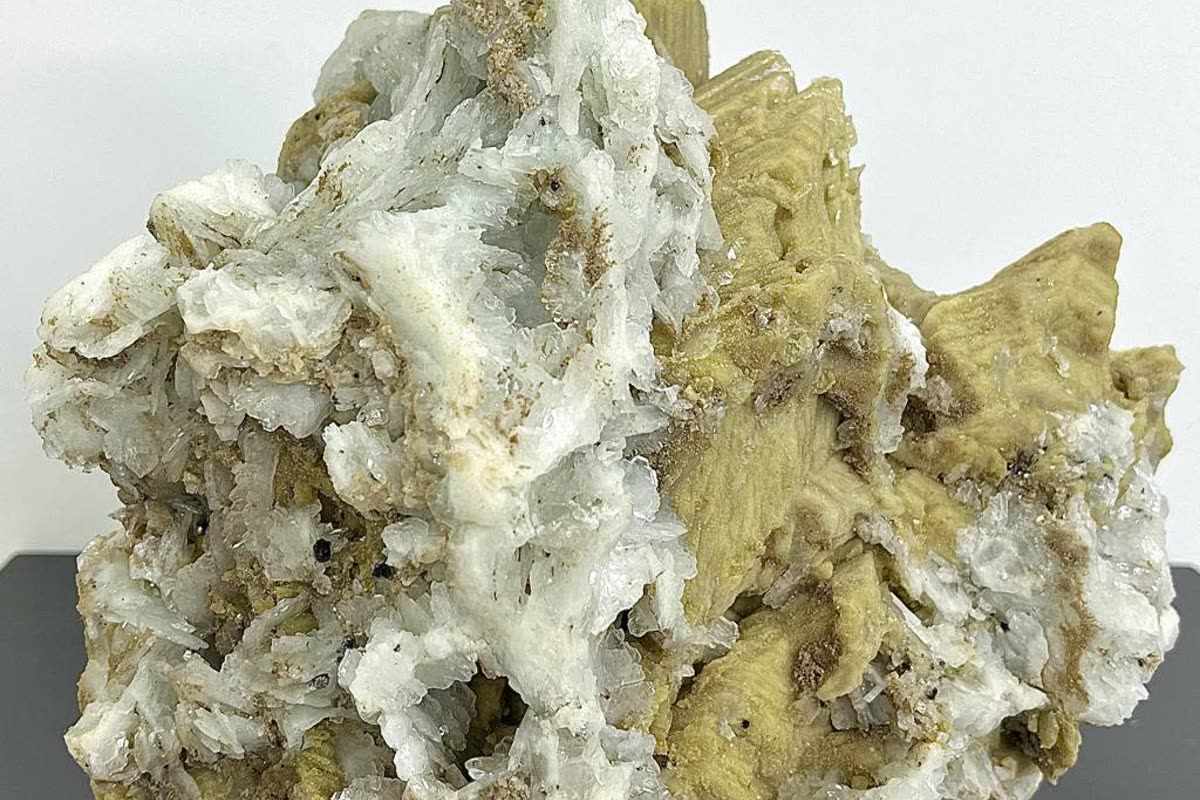
    White and pale yellow zeolite specimen on a dark surface, a premium-tier piece retailers buy wholesale alongside common crystals

    Calculate the True Cost of Your Inventory

    The unit price is not your cost. Rather, your cost is everything you spend to get a sellable item onto a shelf, divided by the number of items that are actually sellable.

    Landed cost per sellable unit =

    ( product cost + international freight + duties and customs fees + insurance + packing, if billed + broker fees + inland freight + breakage allowance + your own handling and photography time ) ÷ number of units you can actually sell

    Two line items get skipped, but both matter. Breakage is real in this category (stone is brittle and heavy) so carry an allowance rather than pretending it is zero. And sellable units is not the same as units received: on unsorted mine-run material, a meaningful share may be unsellable at retail. In other words, a cheap lot with a 40% reject rate is not cheap.

    The detail on pricing structure is in How Much Are Crystals Wholesale?, and the retail side in How to Price Crystals to Sell.

    How to Reduce Risk the First Time You Buy Crystals Wholesale

    1. Order small on purpose. A deliberately undersized first order is tuition, not inventory. Its job is to test the supplier, not to fill the store.
    2. Ship it by air, even if ocean is cheaper. After all, you want the feedback loop short. Learn whether the packing survives before you commit a container to it.
    3. Get it in writing. Species, quantity, size range, grade, treatment status, term (FOB/CIF/DDP), packing, lead time. A dispute about an undocumented expectation is a dispute you lose.
    4. Photograph the shipment before unpacking. Crate condition, then each layer. If there is breakage, the claim depends on evidence you can only capture once.
    5. Compare arrivals against the descriptions, item by item. Not impressionistically: against the spec you agreed.
    6. Buy the mid-tier first. It carries the margin, and it also turns. Statement pieces can wait until you trust the supplier.
    7. Use a customs broker on the first import. The fee is small against the cost of a misclassification that repeats across every subsequent shipment (see CBP importing basics).
    8. Do not commit to exclusivity early. Agreeing to be someone’s only channel in your city, before you know whether they can reorder consistently, is a risk with no upside.

    Build a Reordering Strategy for Crystals You Buy Wholesale

    The first order is the easy part. You build the business in the second, fifth and twentieth.

    • Separate repeatable from unrepeatable. You can reorder polished goods cut to specification, but not found pieces. Track them as two different inventory classes with two different replenishment logics, because trying to reorder a unique piece is a conversation that ends in disappointment.
    • Track sell-through by tier, not just by SKU. If your volume tier is turning and your mid tier is not, the problem is the mid tier’s selection, not the total budget.
    • Set reorder points on your slowest lane. If replenishment comes by ocean, your reorder trigger has to sit weeks ahead of the stockout. Most stockouts in this category are calendar failures, not demand surprises.
    • Buy seasonally, deliberately. Gift-driven demand concentrates in the fourth quarter, which means the buying decision happens in the third: earlier than feels natural if freight is slow.
    • Give the supplier forecast, not surprises. A supplier who knows what you will likely need in ninety days can hold material for you. One who only hears from you when you are out cannot.
    • Review the relationship, not just the invoice. Once a quarter: was quality consistent, was communication good, did lead times hold? Suppliers drift, and the drift shows up in these three before it shows up in price.

    How CS Minerals Works With Wholesale Buyers

    CS Minerals is a Brazilian supplier selling crystals, minerals and natural stones to wholesale and professional buyers in the United States. The process:

    1. Wholesale access. You request access and describe your business and buyer profile, so the assortment offered matches what you actually sell.
    2. Selection. From catalog material, from photographs and video of specific units, or live: with pieces handled on camera so you can judge size and color before claiming them.
    3. Quote on clear terms. Unit or lot pricing with the commercial term stated, so you can calculate landed cost rather than guess at it.
    4. Packing and shipping. Packed for international transit and shipped by air or ocean depending on the weight and urgency of the order.
    5. A named contact through the order rather than a generic inbox, which matters most when something needs resolving.

    We set minimums, payment terms and lead times by buyer profile.

    Related reading: Brazilian Crystal Wholesale Supplier, Who Are the Best Wholesale Crystal Suppliers? and Do I Need a License to Sell Crystals?

    How to Buy Crystals Wholesale: Frequently Asked Questions

    From four types of seller: exporters in the countries where the material is mined, importers and distributors in your own country, wholesale marketplaces, and dealers at gem and mineral trade shows. Which is right depends on the material and the volume you need, mapped in our guide to wholesale sourcing channels

    Most wholesalers sell only to businesses and ask for a resale certificate or equivalent before opening an account, because that documentation is what allows a tax-exempt wholesale purchase. Exact requirements depend on your state and on the supplier. This is general information, not legal advice: confirm with your state revenue authority.

    There is no single industry figure. For example, marketplaces and domestic distributors may have minimums measured in one box. In contrast, suppliers at origin size direct orders around an international shipment. Rough and bulk material usually carries weight-based minimums, while unique statement pieces are frequently sold as single units. Ask which basis applies and whether it is per SKU or per order.

    Yes. Small retailers typically start with a domestic distributor or a marketplace, where minimums are low and no customs process is involved, then move to direct import once sell-through data justifies the freight and the larger commitment. Starting with direct import is possible but concentrates a lot of learning into one expensive order.

    Domestic buying wins on speed, small minimums and certainty. Direct import, on the other hand, wins on unit price, selection, access to unique pieces and exclusivity. Most established retailers use both deliberately: domestic for replenishing proven SKUs, direct import for differentiation and margin.

    Start from landed cost per sellable unit, product cost plus freight, duties, insurance, packing, broker and inland fees, plus a breakage allowance, divided by the units you can actually sell. Then apply your retail price. Gross margin is (retail − landed cost) ÷ retail. Note that markup and margin are different numbers: doubling your cost is a 100% markup and a 50% margin.

    Yes. CS Minerals packs orders for international transit and ships to buyers in the United States by air or ocean freight depending on the weight and urgency of the order.

    Request Wholesale Access

    Ready to buy? Request wholesale access to CS Minerals for current availability, pricing and shipping options to the United States.

    About CS Minerals

    CS Minerals is a Brazilian supplier of crystals, minerals and natural stones serving wholesale buyers, retailers and professional buyers in the United States. The company combines Brazilian sourcing, product curation, live selling and international logistics to connect buyers with Brazilian stones and minerals.

    Written by the CS Minerals Wholesale Team · Last updated
    General commercial information, not customs, tax or legal advice. Confirm licensing and import requirements with your state authority and a licensed customs broker.
  • Where Can I Buy Crystals Wholesale?

    Where Can I Buy Crystals Wholesale?

    Quick answer: You can buy crystals wholesale from four types of seller: exporters in the countries where the material is mined, importers and distributors inside your own country, wholesale marketplaces, and dealers at gem and mineral trade shows. What material you need and how much of it should decide which one you use, not which is easiest to find.

    Material drives geography. Amethyst geodes, agate, quartz and tourmaline come mainly from Brazil and Uruguay. Labradorite, celestite and ocean jasper come from Madagascar. Zeolites come from India. Fluorite comes largely from China. As a result, no single supplier is genuinely strong in all of them, and a supplier claiming to be is usually reselling. This guide maps the origins, then the channels.

    The Two Questions That Decide Where to Buy Crystals Wholesale

    Before comparing suppliers, answer these two. They eliminate most of the options for you.

    1. What material do you actually need? Crystal species are geographically concentrated because they form in specific geological conditions, and those conditions are not evenly distributed. A supplier who mines or buys at origin in one country will be genuinely competitive in that country’s material but it will be a reseller in everything else, at a reseller’s price.

    2. How much, and how often? Bulk material by the kilogram, repeatable polished SKUs, and one-of-a-kind display pieces are three different businesses with three different supply chains. For example, a buyer needing 200 kg of tumbled stone and a buyer needing one 300-kilogram cathedral should not be talking to the same channel.

    Countries to Buy Crystals Wholesale From, and What Each Produces

    CountryKnown forNotes for buyers
    BrazilAmethyst geodes and cathedrals, agate, clear/smoky/rose/rutilated quartz, tourmaline, aquamarine and other beryls, imperial topazThe broadest single-country range, spanning bulk material and very large decorative pieces
    UruguayDeep-purple amethyst geodesSame geological formation as southern Brazil, although typically with darker saturation and smaller cavities
    MadagascarLabradorite, celestite, rose quartz, ocean jasper, septarianDistinct material set with little overlap with Brazil
    IndiaZeolite family (from the Deccan basalts), agate, quartz, carved and polished goodsStrong in finished lapidary work and low-cost polished volume
    MoroccoVanadinite, geodes, fossils, azuriteWell established at trade shows, but verify specimen authenticity carefully
    ChinaFluorite, quartz, stibnite, plus large-scale lapidary manufacturingDominant in low-cost worked goods; also a real source of fine specimens
    Pakistan / AfghanistanTourmaline, kunzite, aquamarine, lapis lazuli (Afghan)High-quality pegmatite material, although logistics and documentation need care
    ZambiaAmethyst, emeraldAmethyst with a distinct color character from South American material
    DR CongoMalachite, cobaltoan calciteResponsible-sourcing diligence is not optional here
    PeruPyrite, blue opal, chrysocollaStrong in specimen-grade pyrite
    MexicoGeodes, Veracruz amethyst, fire agate, seleniteProximity to the US makes freight simple
    United StatesArkansas quartz, Oregon sunstone, Utah and Tennessee materialDomestic origin, so no import process at all

    Two practical readings of this table. First, if your assortment spans several of these rows, you are going to have more than one supplier: plan for that rather than hunting for a single source that covers everything. Second, when a supplier quotes you material from a country it has no operational connection to, you are paying a margin you could have skipped by going to a specialist in that origin.

    Where to Buy Crystals Wholesale: Channel by Channel

    Origin exporters

    Companies located in the producing country that buy at or near the mine and export. They offer the best selection and best unit price in their own material, and they are the only channel where genuinely unique large pieces are reliably available. You handle freight and US customs unless you buy DDP. Minimums, however, reflect a full shipment.

    Importers and domestic distributors

    Companies in your own country that already imported and warehouse the goods. Fast, small minimums, no customs, dollar pricing. However, you are buying a selection someone else made, at their landed cost plus margin, from a catalog every competitor can also order.

    Wholesale marketplaces

    Platforms aggregating many suppliers behind one account. They are the lowest-friction way to place a first order, but also the weakest way to differentiate. They are useful for testing a category, but a poor foundation for a store whose identity depends on exclusivity.

    Trade shows

    The only channel where you judge material by hand. For a US buyer the anchor is the Tucson Gem, Mineral & Fossil Showcase in Arizona: dozens of concurrent shows from late January into mid-February each year. The Denver Gem & Mineral Show then runs in September, and the Munich Show in Germany follows in late October. Shows are where most buyers find the suppliers they then reorder from directly all year.

    Live selling

    The supplier broadcasts and handles pieces on camera while buyers claim specific units. This is the practical remote solution for one-of-a-kind inventory, and the weakest channel for precise replenishment, because you buy what is on the table that day.

    What “Bulk” Means When You Buy Crystals Wholesale

    Sellers use “bulk” loosely, and that costs buyers money. There are three distinct things behind the word, and the price difference between them is large:

    TermWhat you receiveWho it suits
    Mine run (unsorted)Material as it came out, ungraded: excellent pieces and unsellable pieces in the same lotBuyers who can sort, cut or absorb waste, and who want the lowest cost per kilogram
    Graded lotsPre-sorted into quality and size bandsRetailers who need predictable sell-through and cannot afford to sort
    Flats and assortmentsA fixed tray or box with a defined mixBuyers filling a display or a price point quickly

    A mine-run quote and a graded quote for “the same” material are not comparable. Before comparing prices per kilogram, ask what percentage of a mine-run lot the supplier expects to be retail-sellable. If they cannot give you a straight answer from experience, the cheap lot is not cheap.

    The other bulk trap is weight itself. Stone is dense, so freight on heavy low-value material can exceed the cost of the goods. Run the landed cost per sellable unit before committing to tonnage: the method is in How Much Are Crystals Wholesale?

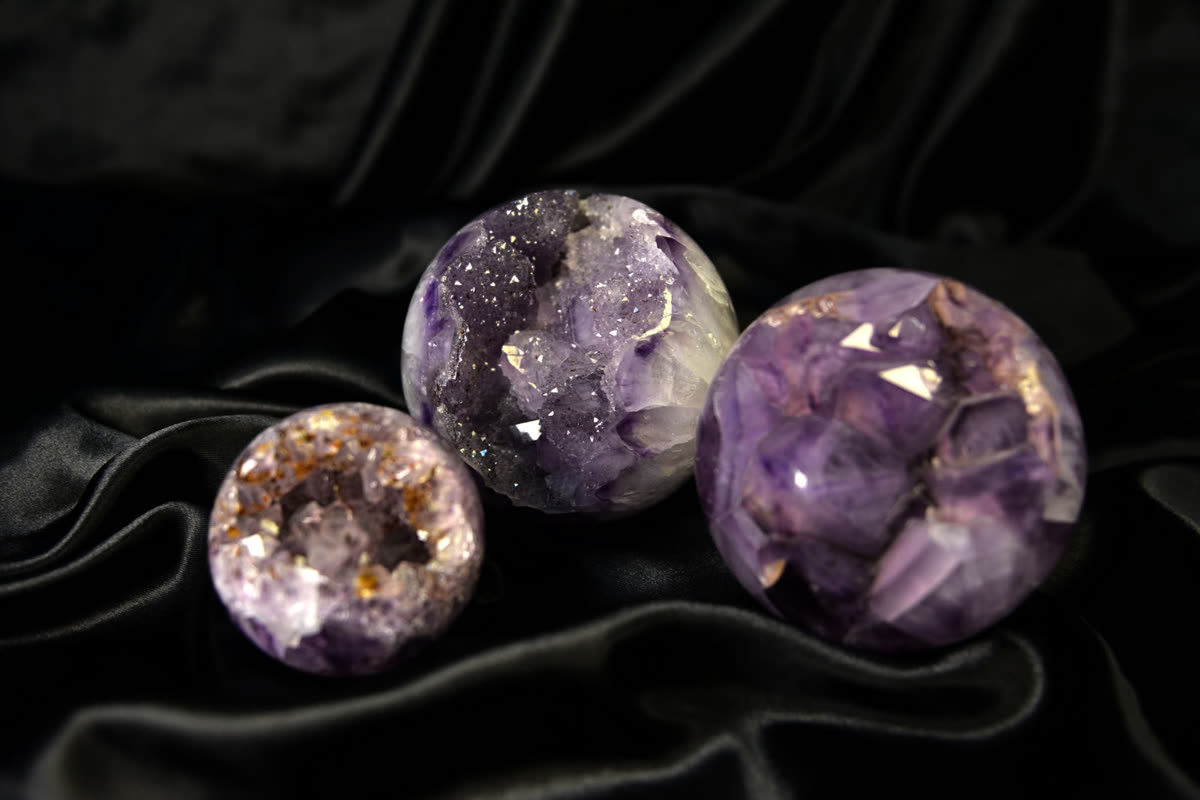
    Three polished amethyst spheres in graded sizes on black fabric, a repeatable line retailers buy wholesale among other crystals

    Responsible Sourcing: Questions That Should Not Be Optional

    Mineral supply chains vary enormously in transparency. Some origins carry documented concerns around labour conditions, informal and unsafe extraction, and conflict financing. None of that is an argument against importing: it is an argument for asking.

    • Can the supplier state the region or district a lot came from?
    • Can they provide legal origin and export documentation?
    • Do they buy at the mine, at a cutting center, or from another exporter? (All three are legitimate; the answer tells you how much they actually know about origin.)
    • For origins with known concerns, what diligence do they perform?

    A supplier who treats these as reasonable commercial questions is one you can build on. On the other hand, a supplier who treats them as an insult has told you something useful.

    Building a Multi-Origin Base to Buy Crystals Wholesale

    The pattern that works for an established retailer is not one supplier, and not twelve. It is usually:

    1. One origin supplier for your core category: the material that is most of your revenue, bought as close to the mine as you can reach.
    2. One domestic distributor for fast replenishment of proven SKUs, so a stockout never waits on ocean freight.
    3. A specialist or two for origins outside your core, used opportunistically rather than continuously.
    4. A show or live channel for discovery: the pieces you would never have thought to order.

    In short, that structure gives you margin on the bulk of your sales, speed where you need it, and differentiation on top. In contrast, trying to do all four through a single supplier is how retailers end up with a catalog identical to everyone else’s.

    How CS Minerals Fits

    CS Minerals is an origin supplier in the first row of the table above: a Brazilian company sourcing crystals, minerals and natural stones at origin across Brazilian producing regions and selling them to wholesale and professional buyers in the United States, through direct orders and live selling.

    Which means it is the right channel for Brazilian material (amethyst, quartz, agate, tourmaline, beryls and Brazilian decorative stone) and not the right channel for Madagascan or Indian material. Saying so is more useful to a buyer than claiming to cover everything.

    Related reading: Brazilian Crystal Wholesale Supplier, Where to Source Brazilian Stones at Origin and our step-by-step wholesale buying guide.

    Where to Buy Crystals Wholesale When You Are Starting From Zero

    Every channel above assumes a buyer who already knows what they want. A first order rarely works that way, and the sequence matters more than the channel.

    Start by buying a small assortment from a domestic distributor, even at a higher unit cost. What you are buying is not inventory but information about what your customers actually pick up. Once two or three categories prove themselves, move those specific lines closer to origin where the margin is, and leave the rest with the distributor.

    This sequence costs a little more at the start, but it avoids the common failure, which is committing capital to an import of material nobody in your market wanted.

    The distributor stays useful even after you import directly. In fact, it becomes the way you cover gaps between shipments without stocking out on a line that sells.

    Whichever channel you settle on, write down what you expected the landed cost to be before the first shipment arrives. Comparing that number to what actually happened is the only way a channel decision stops being a guess on the second order.

    Where to Buy Crystals Wholesale: Frequently Asked Questions

    There is no single best place, because the answer depends on the material. For amethyst, agate, quartz and tourmaline, buying at origin in Brazil gives the widest selection and best unit price. Madagascar specialists, on the other hand, are the right channel for labradorite and ocean jasper. For speed and small minimums on proven SKUs, a domestic distributor beats both. Most established retailers use two or three channels deliberately.

    Bulk material (sold by the kilogram rather than by the piece) comes from origin exporters and from importers who break down container quantities. Before ordering, establish whether the lot is mine run (unsorted) or graded, because the price difference reflects how much of the lot will actually be sellable at retail.

    Brazil is the most commonly cited source and offers the broadest single-country range, from bulk quartz and agate to amethyst cathedrals weighing hundreds of kilograms. But “most” depends on species: Madagascar, India, China, Morocco, Pakistan, Peru and Mexico each dominate material that Brazil does not produce in quantity.

    Most wholesalers sell only to businesses and will ask for a resale certificate or equivalent documentation before opening an account, partly because that documentation is what lets you buy without paying sales tax. Requirements vary by supplier and by state. See Do I Need a License to Sell Crystals?

    Ask for video of a specific piece filmed in ordinary daylight with a scale reference, ask which region the material came from, and ask whether any treatment has been applied. Suppliers with real inventory answer all three quickly. Then place a deliberately small first order and compare what arrives against what was described before committing to volume.

    CS Minerals is a Brazilian origin supplier, focused on crystals, minerals and natural stones from Brazilian producing regions. So buyers building an assortment that spans other origins will generally combine a Brazilian origin supplier with specialists in those other regions.

    Request Wholesale Access

    Sourcing Brazilian crystals for your store or studio? Request wholesale access to CS Minerals for current availability, pricing and shipping options to the United States.

    About CS Minerals

    CS Minerals is a Brazilian supplier of crystals, minerals and natural stones serving wholesale buyers, retailers and professional buyers in the United States. The company combines Brazilian sourcing, product curation, live selling and international logistics to connect buyers with Brazilian stones and minerals.

    Written by the CS Minerals Wholesale Team · Last updated
    General commercial information, not customs, tax or legal advice. Trade show dates change: confirm with the organizer before travelling.

  • Where Can I Buy Brazilian Crystals Wholesale?

    Where Can I Buy Brazilian Crystals Wholesale?

    Quick answer: You can buy Brazilian crystals wholesale through five practical channels: directly from a Brazilian supplier or exporter, from a US importer or distributor, in person at a gem and mineral trade show, through live selling broadcasts, or on a wholesale marketplace. Each one trades a different thing away.

    Direct from Brazil gives you the widest selection and origin-level pricing, but requires freight and customs handling. In contrast, a US distributor gives you speed and small minimums at a higher unit cost. Trade shows let you inspect goods by hand once or twice a year. Live selling lets you claim specific one-of-a-kind pieces remotely. Finally, marketplaces are the easiest to start on and the hardest to differentiate with. This article therefore compares all five and matches each to a buyer profile.

    The Five Ways to Buy Brazilian Crystals Wholesale

    1. Buy Brazilian crystals wholesale direct from a supplier or exporter

    You place the order with a company located in Brazil. It selects and packs the material, handles export documentation, and ships to you by air or ocean freight. You act as importer of record in the United States unless the quote is on DDP terms.

    This is the channel with the widest selection, because you are buying from the point in the chain where the material is still ungraded and unfiltered by someone else’s guess about what the US market wants. It is also the channel where one-of-a-kind pieces are still available: large cathedrals and sculptural specimens are usually claimed before they ever reach a distributor’s catalog.

    What it costs you: freight timelines, a customs process, and a larger commitment per order. Suppliers size the minimum around an international shipment rather than a box.

    2. From a US importer or distributor

    A company that already imported Brazilian material and warehouses it domestically. You order in dollars, it ships domestically, and no customs process touches you.

    This is the fastest and lowest-risk way to buy Brazilian material, and for replenishing proven, fast-moving SKUs it is often the correct answer. The limitation, however, is structural: you are choosing from a selection someone else made months earlier, at a price that includes their import cost and their margin. As a result, every other retailer buying from that distributor sees the same catalog.

    3. At a gem and mineral trade show

    Brazilian dealers and exporters exhibit at the major international shows, and you buy with the material in your hands. The anchor events for a US buyer:

    • The Tucson Gem, Mineral & Fossil Showcase in Tucson, Arizona: dozens of concurrent shows spread across the city from late January into mid-February each year, anchored by the Tucson Gem & Mineral Society show at the end. It is the largest gathering of its kind, and therefore where a great deal of Brazilian material changes hands.
    • The Denver Gem & Mineral Show in Colorado, in September.
    • The Munich Show (Mineralientage München) in Germany, in late October: relevant if you also buy European and African material.

    Shows solve the single hardest problem in this trade, which is judging a stone you cannot touch. The cost, however, is that they happen on a calendar, not on your schedule: a show buyer commits capital in a two-week window and then waits a year. Most established buyers use shows to find suppliers and then reorder from them directly for the other eleven months.

    4. Through live selling

    The supplier broadcasts, handles each piece on camera, and buyers claim specific units in real time. For unique pieces, this is therefore the closest remote equivalent to a trade show: you see the actual stone turning under light, at scale, next to a reference object, and you can ask about a fracture or a base before you commit.

    It works best for statement pieces and mixed lots, and least well for precise replenishment, because you are buying what is on the table that day rather than a SKU you specified. Buyers who use this channel well treat it as discovery (they find pieces they would never have thought to order) and keep a separate catalog channel for the predictable part of their inventory.

    5. On wholesale marketplaces

    Aggregator platforms that list many suppliers under one account and one checkout. The easiest channel to start on: low minimums, card payment, buyer protection, no relationship to build.

    The trade-off, however, is differentiation. Marketplace inventory is, by design, the inventory every other buyer can also see and order. It is a reasonable way to test a category before committing to it, but a poor foundation for a store whose identity depends on having pieces nobody else has.

    Comparing the Channels to Buy Brazilian Crystals Wholesale

    ChannelSelectionUnit priceMinimumSpeedUnique piecesCustoms on you
    Direct from BrazilWidestLowestHighestWeeksYesYes, unless DDP
    US distributorPre-filteredHighestLowestDaysRarelyNo
    Trade showWide, but only during the showLow to mediumVaries by dealerImmediate or shippedYesDepends on the dealer
    Live sellingWhatever is on the tableLow to mediumOften lowDays to weeksYes: its main strengthDepends on the seller
    MarketplaceNarrow and widely availableMedium to highLowestDaysAlmost neverNo

    Which Way to Buy Brazilian Crystals Wholesale Fits Your Business

    • Opening a first crystal or metaphysical store? Start with a US distributor, then a trade show, because you need to learn what sells before you commit import capital.
    • Running an established store with proven sell-through? Buy direct from Brazil and keep a distributor for replenishment, because your volume now justifies the freight and margin is the constraint.
    • Selling online or live? Combine live selling with direct orders, since your format rewards pieces nobody else is showing.
    • Making jewelry or cutting stone? Buy direct from Brazil, because rough and preforms are weight-based, travel well and import cleanly.
    • Sourcing for one interior design project? Buy direct on DDP terms, because you need a specific piece delivered, not a catalog, and you do not want to run customs for one item.
    • Testing whether crystals fit your existing shop? Use a marketplace or a distributor for a low minimum, low downside and a fast answer.

    Where Brazilian Crystals Trade Inside Brazil Before You Buy Wholesale

    Knowing the domestic geography also helps you read a supplier. Brazilian stone does not all move through one place:

    • Teófilo Otoni, Minas Gerais: the main trading center for Brazilian colored stones, and the town most international gem buyers pass through. Pegmatite material from the surrounding region concentrates here.
    • Governador Valadares, Minas Gerais: a second Minas trading and cutting center in the same pegmatite belt.
    • Ametista do Sul and the Alto Uruguai district, Rio Grande do Sul: the amethyst geode mining region in the southern basalt.
    • Soledade, Rio Grande do Sul: the processing and cutting hub for agate and amethyst from that region; much of the polished decorative material passes through here.

    A useful question for any supplier claiming Brazilian sourcing: which of these regions does the material come from, and are they buying at the mine, at the cutting center, or from another exporter? None of those answers is wrong, but they imply different prices, and a supplier who cannot answer is probably one step further from origin than they are telling you.

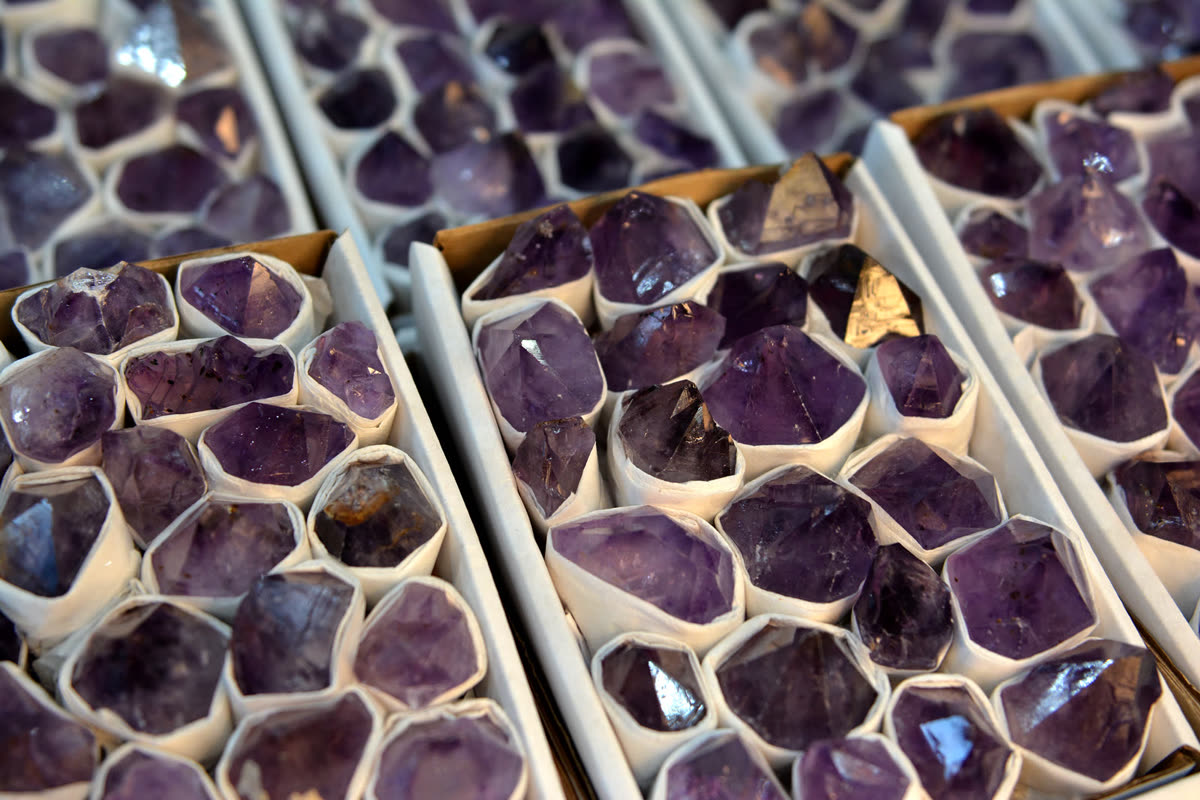
    Many small Brazilian amethyst druzy pieces in rows: a typical wholesale lot of crystals sorted before shipping

    Questions to Ask Before You Buy Brazilian Crystals Wholesale

    1. Which Brazilian region does this material come from?
    2. Is the quote FOB, CIF or DDP? (This moves landed cost more than unit price does.)
    3. What is the minimum, and is it measured by value, by weight or by piece?
    4. Is packing included, and who absorbs breakage in transit?
    5. Can I see video of the specific unit, in daylight, with a scale reference?
    6. Has this material been treated in any way? (Heat-treated citrine is common and legitimate: it just has to be declared.)
    7. What is the realistic transit time, by air and by ocean?
    8. Will you provide the documentation my customs broker needs?

    If a supplier answers all eight without hedging, you are dealing with an operation that exports routinely. For the fuller version of this evaluation, see Who Are the Best Wholesale Crystal Suppliers?

    How CS Minerals Works With US Buyers

    CS Minerals is a Brazilian supplier selling into channels one and four above: direct orders from Brazil, and live selling for buyers who want to claim specific one-of-a-kind pieces remotely. We source material at origin across Brazilian producing regions, select it rather than simply aggregate it, pack it for international transit and ship it to buyers in the United States.

    We set commercial terms (minimum, payment, shipping mode and lead time) by buyer profile, because a jewelry maker ordering rough by weight and a designer specifying a single 300-kilogram cathedral are not the same order.

    Related reading: Brazilian Crystal Wholesale Supplier: How to Buy Directly From Brazil, How to Buy Crystals Wholesale and What Crystals Are Commonly Found in Brazil?

    What Changes After Your First Brazilian Order

    The first order teaches you things the channel comparison cannot. Most buyers discover that the freight estimate was the easy part and the timing was not, because customs clearance varies with the broker rather than the shipment.

    Two adjustments then show up almost universally on the second order. Buyers widen the size range they requested, because a single grade rarely covers a whole display. And they ask for photographs of the actual lot rather than the catalogue, which is the moment a supplier relationship either becomes useful or stays transactional.

    Where to Buy Brazilian Crystals Wholesale: Frequently Asked Questions

    Yes, in two ways. You can buy from a US importer or distributor that already holds Brazilian material domestically, or you can buy direct from Brazil on DDP terms, where the supplier handles freight, duties and delivery to your address. DDP costs more per unit than FOB but removes the customs process entirely.

    Direct is cheaper per unit, but the comparison only means something after freight, duties, insurance, broker fees and inland delivery are added. On small orders those fixed costs can erase the unit-price advantage, whereas on larger orders they are spread thin and direct wins clearly. So compare landed cost per sellable unit, not the quoted price.

    The largest is the Tucson Gem, Mineral & Fossil Showcase in Tucson, Arizona, a cluster of dozens of concurrent shows running from late January into mid-February each year. The Denver Gem & Mineral Show in Colorado then takes place in September. Both host Brazilian dealers and exporters.

    Yes. Live selling exists largely to solve this: the supplier handles each piece on camera so you can judge size, color and condition before claiming it. For a unique piece bought any other way, however, insist on video of that specific unit filmed in ordinary daylight with a scale reference, not a representative catalog photograph.

    It depends on the channel and the supplier. For example, marketplaces and distributors can have minimums measured in a single box. In contrast, suppliers size a direct order from Brazil around an international shipment, and they may express the minimum as an order value, a weight, or a piece count per SKU. Always ask which basis applies before comparing two suppliers.

    Yes. CS Minerals supplies wholesale and professional buyers in the United States, including retail stores, online and live sellers, jewelry makers, designers and collectors. We provide availability, pricing and shipping options on request through the wholesale program page.

    Request Wholesale Access

    Buying Brazilian crystals for your store, studio or project? Request wholesale access to CS Minerals for current availability, pricing and shipping options to the United States.

    About CS Minerals

    CS Minerals is a Brazilian supplier of crystals, minerals and natural stones serving wholesale buyers, retailers and professional buyers in the United States. The company combines Brazilian sourcing, product curation, live selling and international logistics to connect buyers with Brazilian stones and minerals.

    Written by the CS Minerals Wholesale Team · Last updated
    General commercial information, not customs, tax or legal advice. Trade show dates and formats change: confirm with the organizer before travelling.

  • Brazilian Crystal Wholesale Supplier: How to Buy Directly From Brazil

    Brazilian Crystal Wholesale Supplier: How to Buy Directly From Brazil

    Brazilian crystal supplier guide · Wholesale

    Quick answerA Brazilian crystal wholesale supplier is a company that sources crystals, minerals and natural stones from Brazilian mining regions and sells them in commercial quantities to retailers, designers, collectors and other business buyers. US retailers can and do buy directly from Brazil. Buyers select pieces from photos, video or live sales. The supplier then packs them for transit and ships them by air or ocean freight. The goods then clear US customs under the importer’s own tariff classification.

    Buying direct generally means wider selection, access to one-of-a-kind pieces and origin-level pricing. Buying from a US distributor generally means faster delivery, smaller minimums and no customs paperwork. This guide covers what Brazil actually produces, who buys it wholesale, how a direct order works step by step, how to vet a supplier, and how the two sourcing routes compare.

    Why Brazil Is One of the World’s Most Important Sources of Crystals

    Brazil is one of the leading producers of colored gemstones and quartz in the world. It holds that position for a structural reason. The country contains several completely different geological environments, and each one produces a different family of crystals. A supplier based in Brazil can therefore fill an order spanning faceting-grade rough, tumbled stones and a 300-kilogram amethyst cathedral. Very few single countries can cover that range.

    Geological diversity

    Brazil covers roughly 8.5 million square kilometers, built largely on ancient Precambrian cratons and overlaid in places by much younger volcanic rock. Three of those settings matter commercially:

    • Granitic pegmatites. Coarse-grained intrusive bodies, concentrated in the eastern states, where slow cooling allowed very large, well-formed crystals to grow. This is the source of tourmaline, beryl (aquamarine and emerald), topaz and gem-quality quartz.
    • Hydrothermal quartz veins. Mineral-rich hot fluids moving through fractures, depositing clear quartz, smoky quartz and rutilated quartz.
    • Basalt flows of the Paraná Basin. Cretaceous lava flows across southern Brazil cooled with gas cavities trapped inside. Those cavities later filled with silica-bearing fluids, forming the agate and amethyst geodes the region is known for.

    The practical consequence for a buyer: pegmatite material and geode material come from different states, different mining operations and different price logics. A supplier who can source both is consolidating two supply chains on your behalf.

    Brazilian crystal regions a supplier sources from

    RegionGeological settingCharacteristic material
    Minas GeraisPegmatite provinceTourmaline, aquamarine and other beryls, quartz crystals, imperial topaz from the Ouro Preto district
    Rio Grande do SulBasalt vesicles (Alto Uruguai / Ametista do Sul district)Amethyst geodes and cathedrals, agate, heat-treated citrine
    BahiaQuartz veins and pegmatitesRutilated quartz from the Novo Horizonte area, clear and smoky quartz, amethyst
    Espírito SantoPegmatite provinceBeryl and tourmaline
    ParaíbaPegmatiteCuprian elbaite tourmaline, discovered in the 1980s at São José da Batalha, which gave the “Paraíba” trade name to this tourmaline type
    GoiásSchist-hosted depositsEmerald

    Types of minerals found in Brazil

    Across those regions, the commercially traded families are:

    • Quartz varieties: clear, smoky, rose, rutilated, amethyst and citrine
    • Agate: banded nodules, frequently cut into slices, bookends, coasters and bowls
    • Tourmaline: specimen crystals, slices and jewelry rough
    • Beryl: aquamarine, emerald and morganite
    • Topaz: including the imperial topaz associated with Minas Gerais
    • Ornamental and lapidary stone: material worked into spheres, towers, bowls, bookends, slabs and sculptural pieces

    What an honest supplier tells youA large share of the commercial citrine on the market is amethyst that producers heat-treat to shift its color. This is a long-standing, accepted practice in the trade, but disclosure is what separates a professional supplier from a problem. Ask, for every lot, whether the material is natural or treated, and expect a straight answer in writing.

    What Can Retailers Buy From a Brazilian Crystal Supplier?

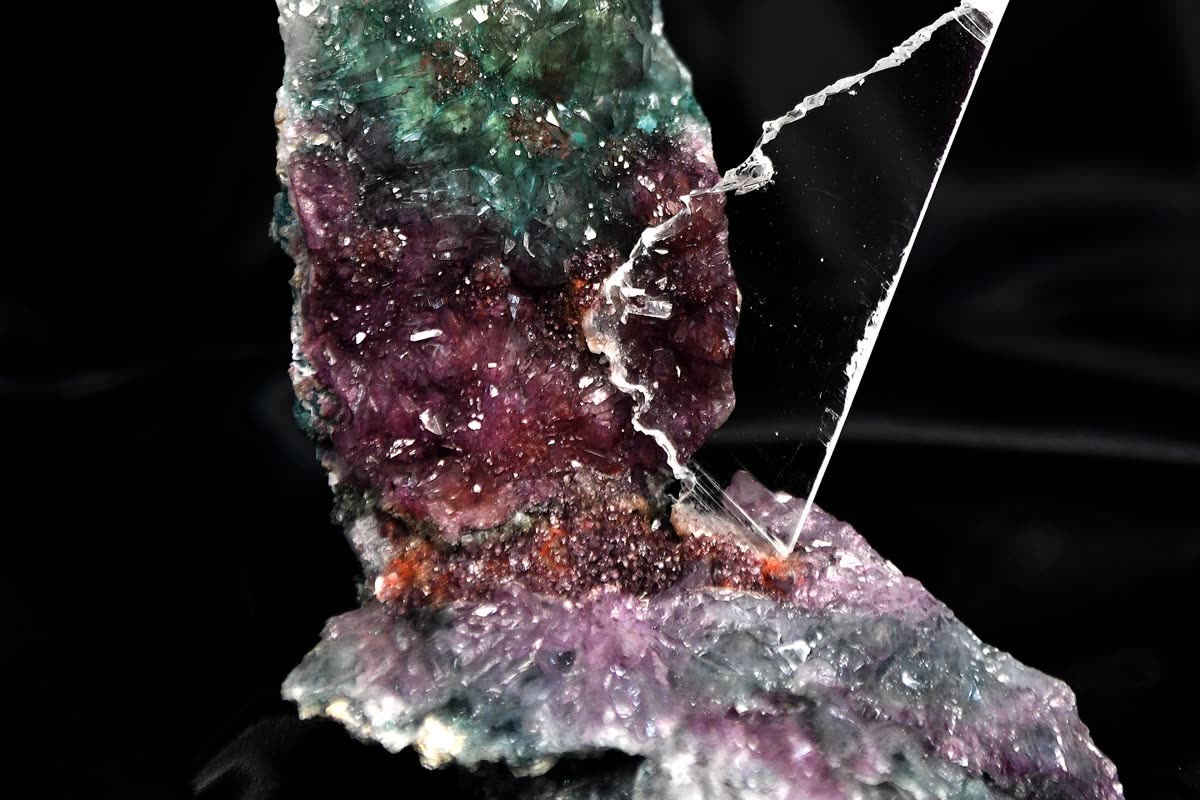
    A premium Brazilian crystal specimen with green and deep purple faces, mounted on a clear acrylic display stand against a dark background
    Specimen grade. Colour zoning across a single piece, mounted on an acrylic stand. At this level price follows colour, integrity and how the piece stands, not weight. Photo: CS Minerals
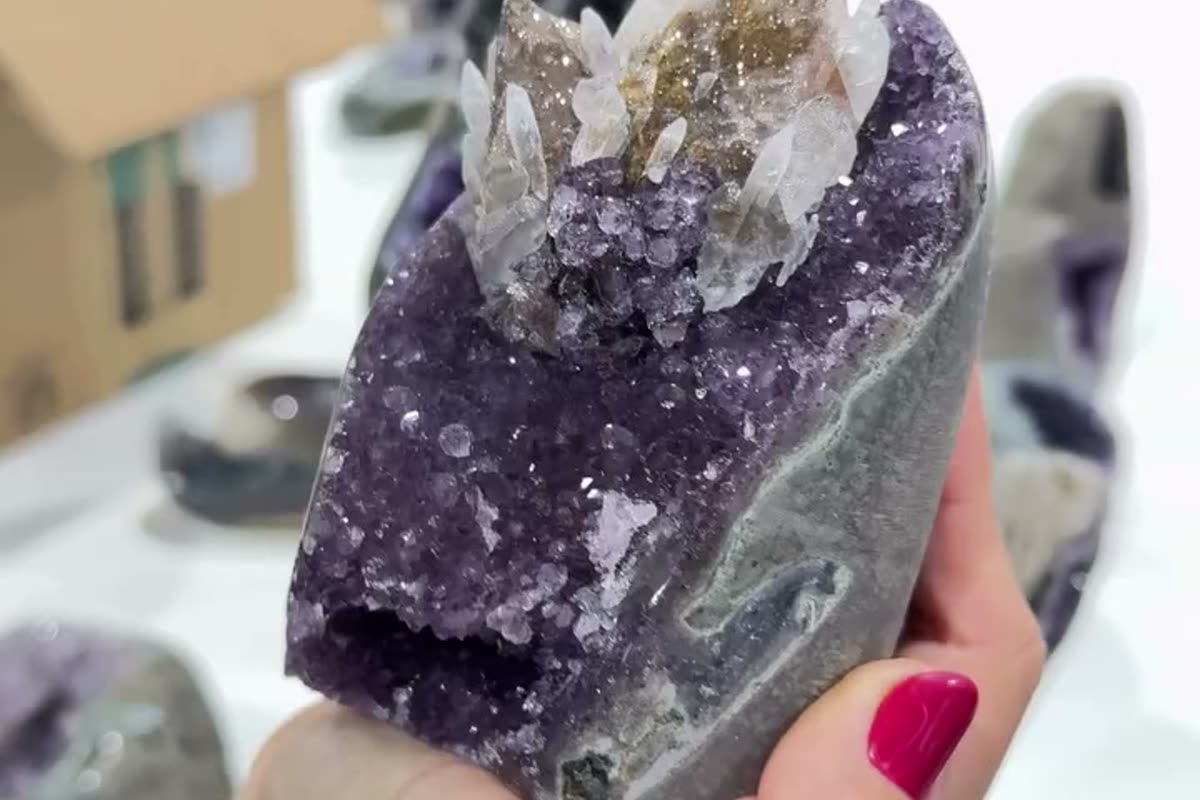
    A Brazilian amethyst geode half with deep purple crystal lining, photographed against the grey exterior of the nodule
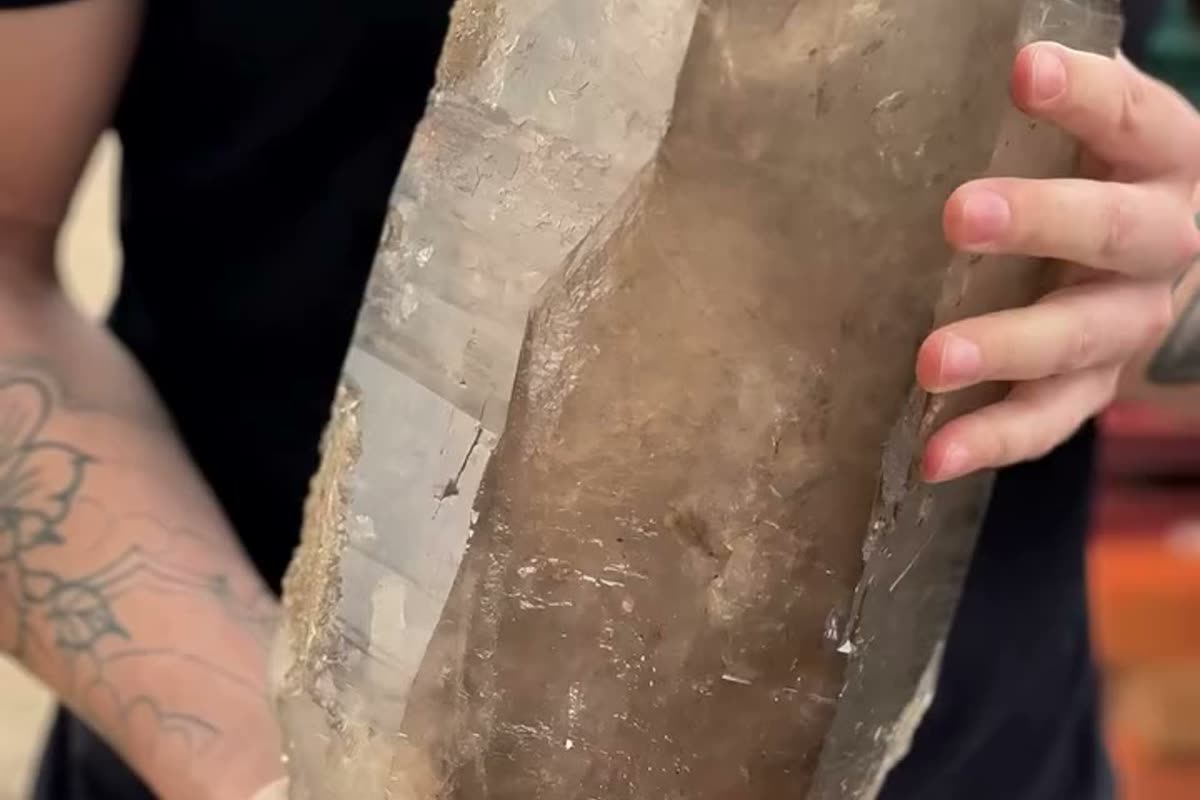
    A polished Brazilian smoky quartz point standing upright, showing the brown-grey colour and internal clarity of the crystal
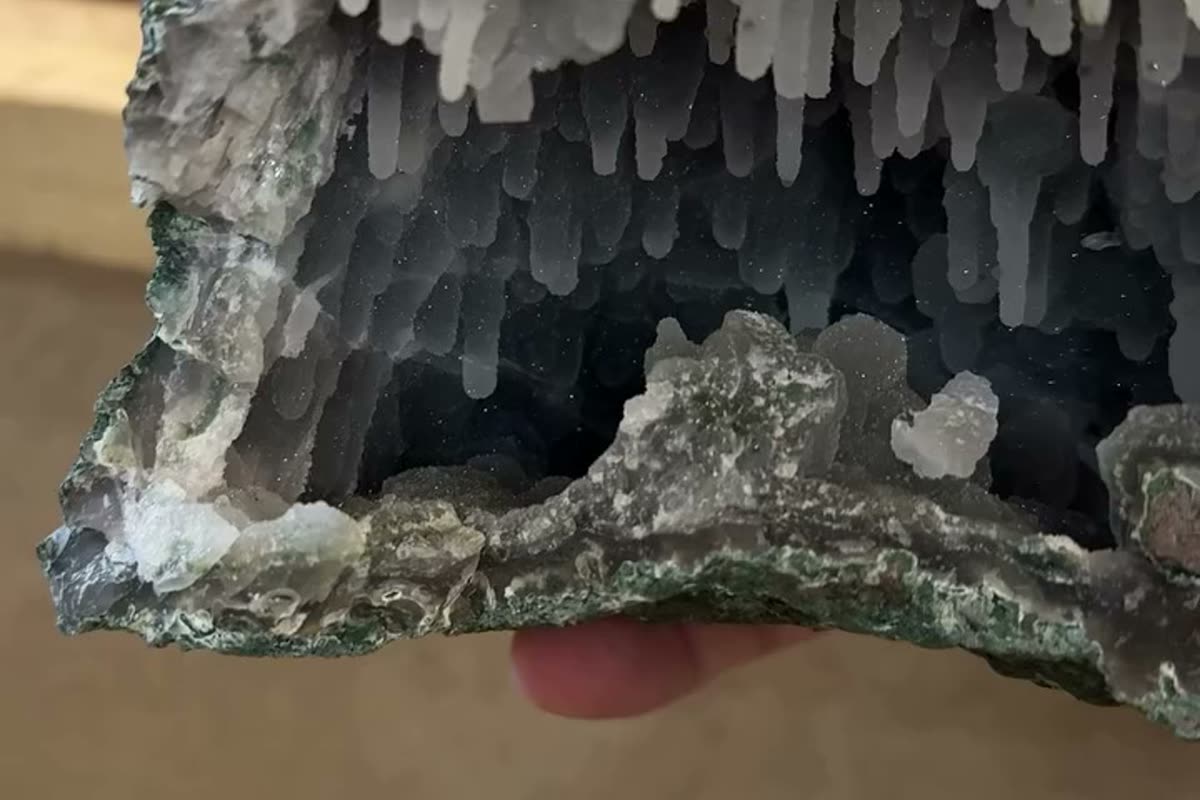
    A chalcedony stalactite formation inside a cut Brazilian geode, showing concentric banding around the central tube

    Three families, one origin. Amethyst geode, smoky quartz point and a chalcedony stalactite: pegmatite, vein and basalt-cavity material, all Brazilian. Photos: CS Minerals

    Amethyst

    The category most associated with Brazil. It arrives in several commercial formats: geode halves, standing cathedrals, clusters, druze plates, polished points and towers, and small tumbled or chipped material for retail bins. Color runs from pale lilac to deep purple, and saturation is usually stronger in smaller, tighter cavities than in very large ones. Size and color grade drive price far more than weight alone.

    Quartz

    The workhorse of any crystal inventory, because it spans every price tier. Clear quartz points and clusters serve entry and mid-price retail. Rose and smoky quartz carry well as polished goods. Rutilated quartz, with golden needle inclusions of rutile, commands a premium. It also photographs extremely well, which matters for online and live sellers.

    Tourmaline

    Pegmatite material, usually the highest per-gram value in a mixed order. It sells as specimen crystals, as polished slices, and as rough or preforms for jewelry makers. This is the category where origin information and clear treatment disclosure matter most, because the value per gram is high enough to justify the diligence.

    Crystal clusters

    Multi-point specimens on a shared matrix. Overall size, point integrity and matrix quality set the price. So does something first-time buyers often overlook: whether the piece stands on its own. Always ask whether a cluster is self-standing or requires a base or mount, because that affects both display and freight.

    Decorative stones

    Worked ornamental goods: spheres, towers, bowls, bookends, coasters, slabs, candle holders and lamp bases. This is the most repeatable part of a crystal catalog. Workshops cut these pieces to specification rather than finding them. As a result, you can reorder them in consistent sizes, which makes them the backbone of a replenishment program.

    Unique statement pieces

    Single large items (tall cathedrals, oversized towers, sculptural specimens) typically ranging from about 20 kilograms to several hundred. Suppliers sell them as individual units, each with its own photographs, weight and dimensions. They are not reorderable: once a specific piece sells, it is gone. For retailers they function as window and destination pieces; for designers they are project specifications.

    Jewelry and craft stones

    Rough and preforms, cabochons, beads, chips and small points for wire wrapping and silversmithing. Suppliers almost always price them by weight rather than by piece. They are also the lowest-friction category for a first order, because weight-based lots are easy to specify and compare. CS Minerals also produces finished jewelry from its own material, hence the “& jewelry” in the company name. That matters if you buy both loose stone and finished pieces.

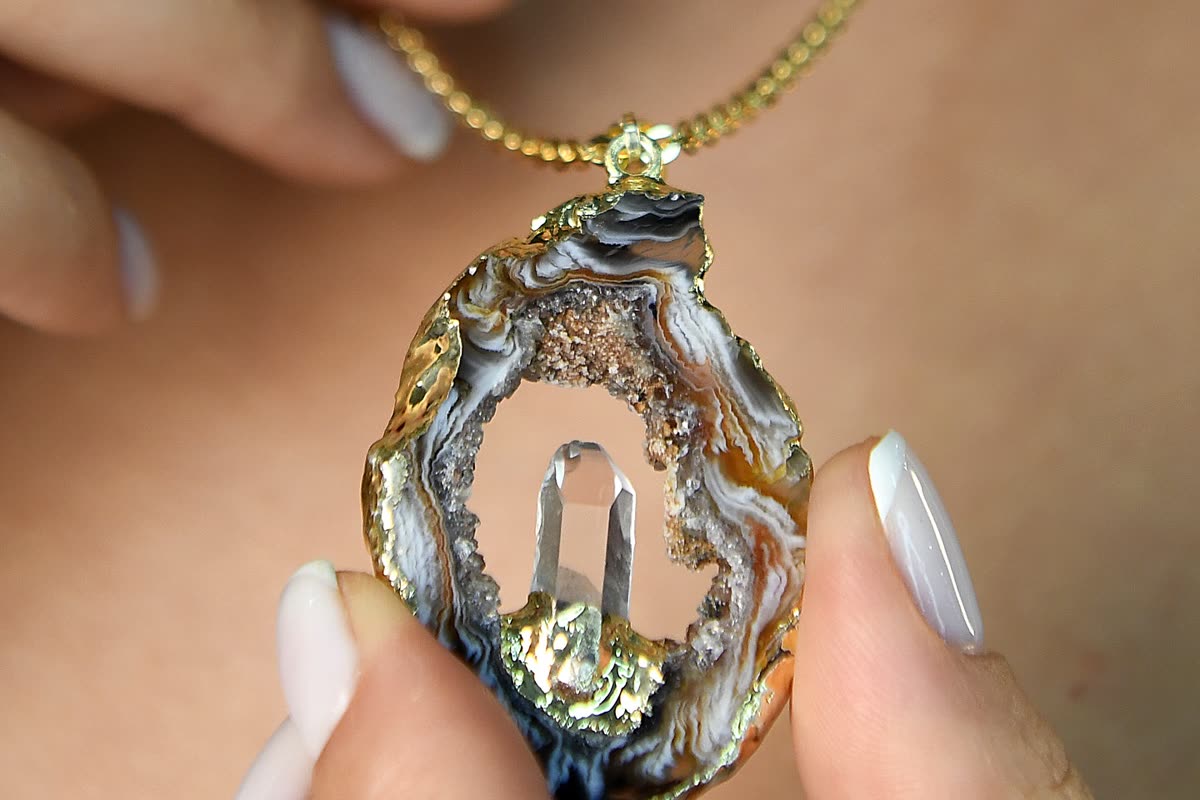
    A banded agate slice pendant in a gold setting, with a clear quartz point mounted inside the open cavity, held between two fingers
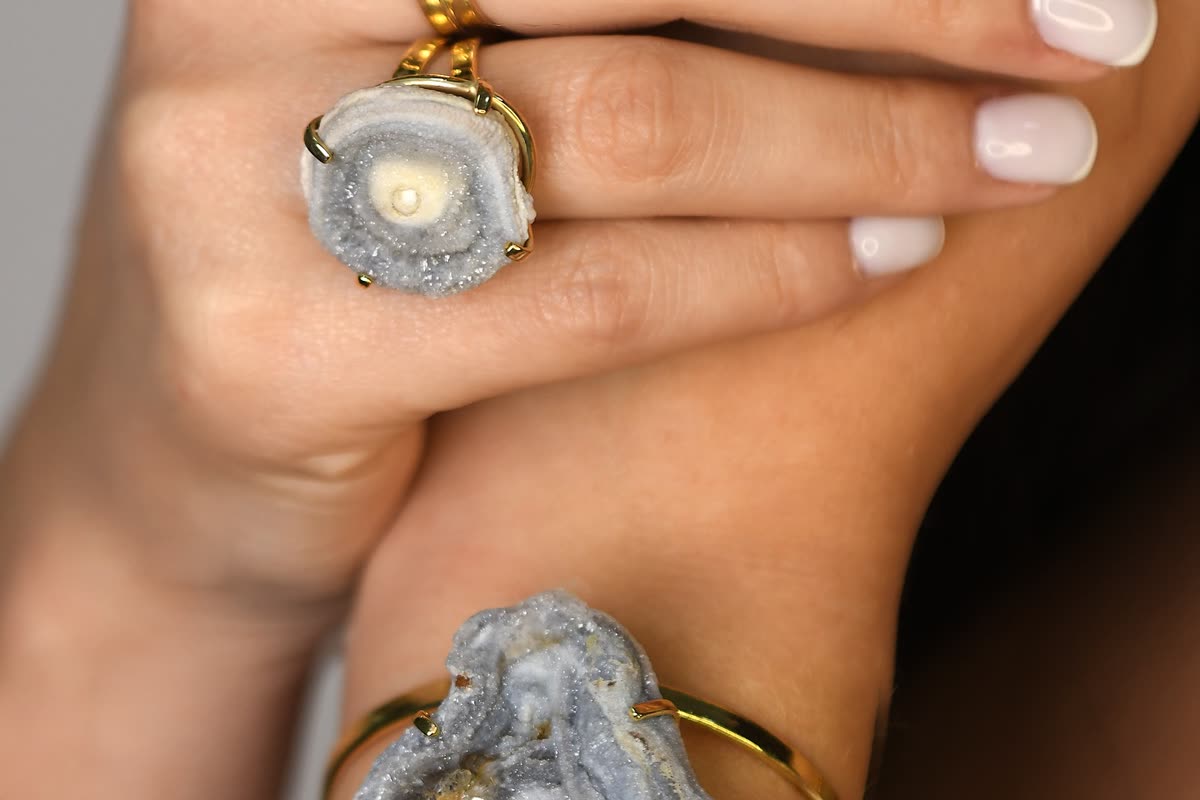
    Two rings and a cuff bracelet set with pale blue-grey chalcedony rosette slices in gold claw settings, worn on a hand
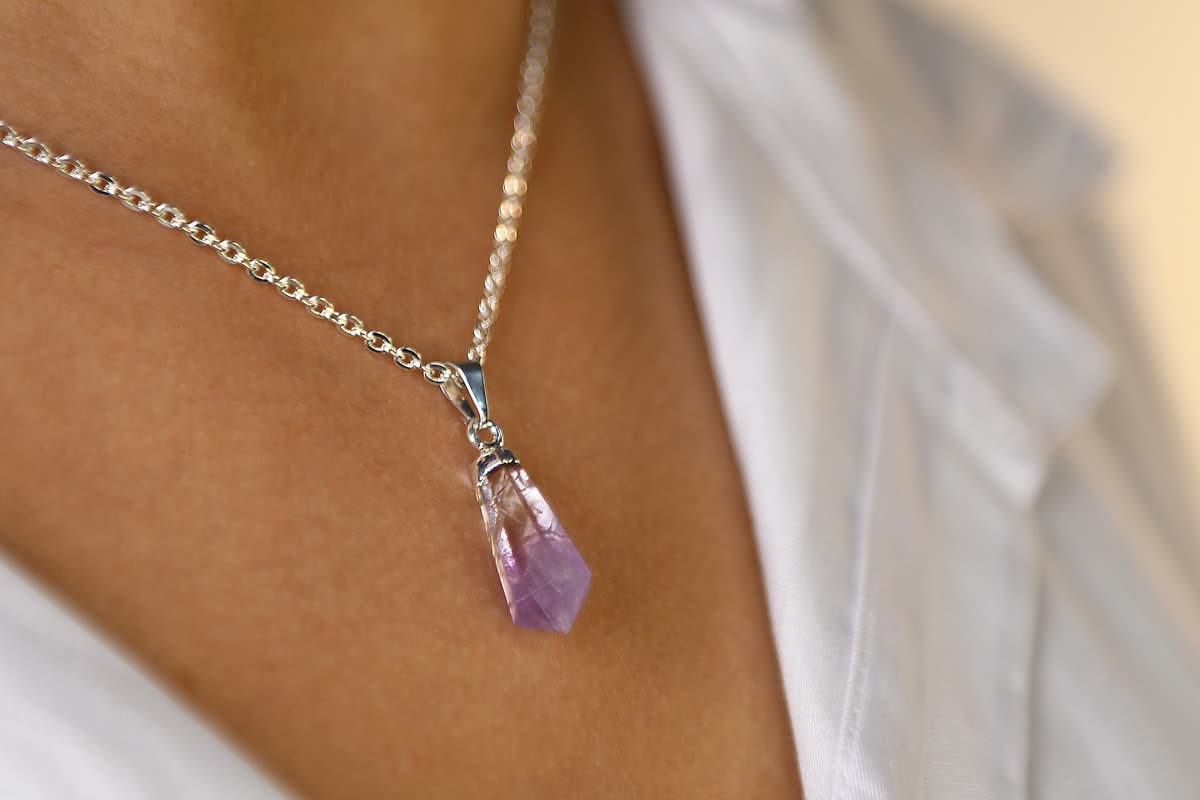
    A faceted pale amethyst pendant on a fine silver chain, worn at the collarbone over a white shirt

    Finished pieces from Brazilian stone. Agate slice, chalcedony rosette and amethyst, set in gold and silver. Hands in frame give the scale reference that a plain product shot cannot. Photos: CS Minerals

    Who Usually Buys From a Brazilian Crystal Supplier?

    • Metaphysical stores order broad assortments across price tiers, plus one or two display pieces, and they care most about product mix and reliable replenishment.
    • Crystal shops buy clusters, towers, polished goods and retail-sized material, so consistency between reorders matters most.
    • Gift shops want low and mid-ticket polished pieces and packaged goods, and they judge them on unit price and sell-through speed.
    • Jewelry stores order finished stones, cabochons and select specimens, and they look first at quality grading and treatment disclosure.
    • Jewelry makers and lapidaries buy rough and preforms by weight, because yield per kilogram and material integrity decide their margin.
    • Product and jewelry designers need specific material in repeatable dimensions, especially availability for a full production run.
    • Interior designers and architects buy large statement pieces, slabs and sculptural specimens, and they need exact dimensions, weight, photography and delivery certainty.
    • Online sellers want photogenic mid-ticket pieces with workable margins, backed by real photography of the actual unit.
    • Live sellers buy mixed lots and graded assortments for on-air selling, so volume, variety and restock cadence come first.
    • Collectors and specimen dealers buy individual high-grade specimens, and locality information and specimen condition matter most to them.

    How Buying From a Brazilian Crystal Supplier Works

    A direct order from Brazil follows roughly the same seven steps every time. Understanding them in advance is what separates a smooth first order from an expensive lesson.

    Choosing products with a Brazilian crystal supplier

    Selection happens in three ways: from a catalog of repeatable SKUs, from photos and video of specific units, or live. In a live broadcast, the supplier handles each piece on camera and buyers claim units in real time. For unique pieces, the only meaningful selection is unit-level: a photograph of “an amethyst cathedral” is not a photograph of your amethyst cathedral. Ask for images of the exact piece you are reserving, with a scale reference in frame.

    MOQ at a Brazilian crystal supplier

    MOQ means Minimum Order Quantity, the smallest order a supplier will accept. It exists because the fixed costs of a wholesale order (handling, packing, export documentation, freight consolidation) do not scale down. Suppliers express MOQ in one of three ways, and the difference is significant:

    • By order value: a minimum dollar amount per order
    • By weight: a minimum number of kilograms, common for rough and bulk material
    • By piece count: a minimum number of units per SKU

    Always ask which one applies, and whether it applies per SKU or per total order. A “50-piece minimum” per SKU and a “50-piece minimum” per order are completely different commitments.

    How a Brazilian crystal supplier prices

    Suppliers normally price bulk and rough material per kilogram, unique pieces per unit and mixed assortments per lot. But the number that actually determines your cost is not the unit price: it is the commercial term attached to it. Ask explicitly which term the quote uses. FOB Brazil means you arrange and pay for freight from the Brazilian port onward. CIF means the supplier covers freight and insurance to the US port, but not duties or inland delivery. DDP means delivered duty paid to your address. Two quotes that look 20% apart on unit price can easily invert once you normalize the terms.

    How a Brazilian crystal supplier should pack

    Crystals are simultaneously brittle and heavy, and that combination is what breaks shipments. Competent packing means individual wrapping, foam or bubble isolation between pieces and double-boxing for mid-size items. Large cathedrals and slabs need custom wooden crates with internal bracing. For anything palletized, ask how the supplier secures the load against shifting. Then ask the two commercial questions: is packing included in the price or billed separately, and who absorbs the cost of breakage in transit?

    A CS Minerals worker crating a large rose quartz gemstone tree on an amethyst base for export, the way a Brazilian crystal supplier packs large pieces
    Crated, not boxed. A rose quartz tree being closed into a purpose-built wooden crate. Anything at this size and fragility needs a crate with internal bracing: a carton is how pieces arrive broken. Photo: CS Minerals

    International shipping

    There are two realistic modes, and the ratio of value to weight dictates the choice:

    • Air freight, days rather than weeks, priced on chargeable weight. It makes sense for high-value, low-weight material: tourmaline, fine specimens, jewelry rough, and any order that has to land before a specific date.
    • Ocean freight, weeks rather than days, priced by volume or container. It is the only economically sensible option for tonnage: geodes, slabs, large decorative pieces. Orders that do not fill a container ship LCL (less than container load, consolidated with other shippers); larger programs move FCL (full container load).

    A frequent first-order mistake is choosing ocean freight for the cost saving. The saving then turns out smaller than expected once LCL consolidation fees, port charges and inland trucking come in. Ask for the all-in landed estimate, not the ocean rate.

    Customs

    In a US import, the importer of record is responsible for correctly classifying the goods and paying any duties owed. Crystals and stones do not have one single tariff line. Classification depends on how worked the material is: unworked, simply sawn, or finished into articles. The applicable rate follows that classification, not the product’s marketing name. Mineral specimens acquired for collections can fall under a different heading again.

    Two practical cautions. First, duty treatment on Brazilian-origin goods has changed more than once in recent years. So verify the current rate for your specific tariff line when you order, rather than relying on an older figure. Second, for a recurring import, request a binding ruling so customs settles the classification before volume builds. Verify current classifications in the USITC Harmonized Tariff Schedule and current procedures with US Customs and Border Protection, and work with a licensed customs broker on the first shipment.

    Delivery

    The final leg is port or airport arrival, broker clearance, and inland trucking to your address. Large statement pieces add two considerations that are easy to forget at the point of order. Can the delivery site receive a pallet, and can anyone on site safely move a 200-kilogram crate? Build the timeline backwards from when you actually need the goods. Also, never schedule a store opening, a trade show or a live event against an ocean shipment without a buffer.

    What to Look for in a Brazilian Crystal Supplier

    • Origin: a good supplier can name the region or district a lot came from, whereas a warning sign is a vague “sourced in Brazil” with no further detail.
    • Quality: it explains its own grading language and applies it consistently, while a weak one describes everything as “AAA” or “premium”.
    • Consistency: a reorder looks like the first order; however, quality that drifts once you are a recurring customer is a warning sign.
    • Packing: it describes materials and method before you ask, but treating packing as an afterthought is a red flag.
    • Communication: it works in English, in your business hours, with named contacts, whereas days of silence mid-order signal trouble.
    • Logistics: it handles export documentation routinely and quotes on clear terms, while “you figure out the shipping” is a warning sign.
    • Real photos: it shows images of the actual unit, unfiltered and with a scale reference, rather than stock imagery or heavily edited color.
    • Video: it sends video of the piece turning under normal light instead of one flattering still image.
    • Range: it can serve several price tiers from a single order, whereas a weak supplier offers only one category or one price point.
    • Track record: it has a verifiable commercial history and contactable references, but no traceable history at all is a warning sign.
    • After-sale support: it states a policy for breakage, shortages and misdescription, whereas a weak supplier’s responsibility ends at the Brazilian port.

    One test cuts through most of the list. Ask for a short daylight video of one specific piece, with something of known size next to it. Suppliers who work with real inventory produce it within a day. It is a small request that reveals a great deal.

    A Brazilian Crystal Supplier vs a US Distributor

    • Variety: buying direct from Brazil shows you the broad range at origin, including material that never reaches the US market, whereas a distributor offers only what it chose to import.
    • Access to origin: direct buyers can request specific regions, formats and grades, while a distributor made its selection for you months earlier.
    • MOQ: suppliers size a direct order around an international shipment, but a distributor can often sell by the box or the piece.
    • Logistics: on a direct order you (or the supplier under DDP) manage freight, clearance and inland delivery, whereas a distributor ships domestically with no customs involvement.
    • Exclusivity: direct buying gives you unique pieces and lots your local competitors do not have, while a distributor offers the same catalog to every other retailer.
    • Price: direct is lower at the unit level, although landed cost depends on freight and duties; a distributor charges more per unit but leaves no import cost or risk to absorb.
    • Lead time: direct takes weeks (days by air, considerably longer by ocean), whereas a distributor delivers in days.
    • Working capital: a direct order commits more capital for longer, while a distributor lets you order against actual demand.
    • Customs responsibility: on a direct order it is yours as importer of record unless the term is DDP, but a distributor leaves you none.

    This is not a decision most established retailers make once. The common pattern is to run both channels deliberately. A domestic distributor handles fast replenishment of proven SKUs. Direct import, meanwhile, covers statement pieces, differentiated assortments and the margin of buying at origin. The direct channel is where differentiation and margin live; the domestic channel is where speed lives.

    How CS Minerals Works as a Brazilian Crystal Supplier for US Buyers

    CS Minerals is a Brazilian supplier of crystals, minerals and natural stones working with wholesale and professional buyers in the United States. We built the operation around four things:

    • Brazilian sourcing. We source material at origin across Brazilian producing regions, which is what makes it possible to offer both repeatable polished goods and one-of-a-kind statement pieces from the same supplier.
    • Curation. We select lots rather than simply aggregate them, so an order arrives as a usable assortment across price tiers instead of an undifferentiated mass of material.
    • Live selling. Buyers can see pieces handled on camera, compare sizes and color in real time, ask questions during the broadcast and claim specific units. For unique pieces, this resolves the core problem of buying remotely: you are looking at the actual unit, not a representative photograph.
    • International logistics and support. We pack orders for international transit and ship them to buyers in the United States, with a named commercial contact through the order rather than a generic inbox.

    Live sales from the warehouse

    Live sales scheduleCS Minerals runs live sales Monday to Friday, 8am to midnight Brazilian time, on Instagram at @csminerals. Brazil is generally one to five hours ahead of the continental United States depending on the season, so the window overlaps the US morning: worth knowing if you plan to buy on air.

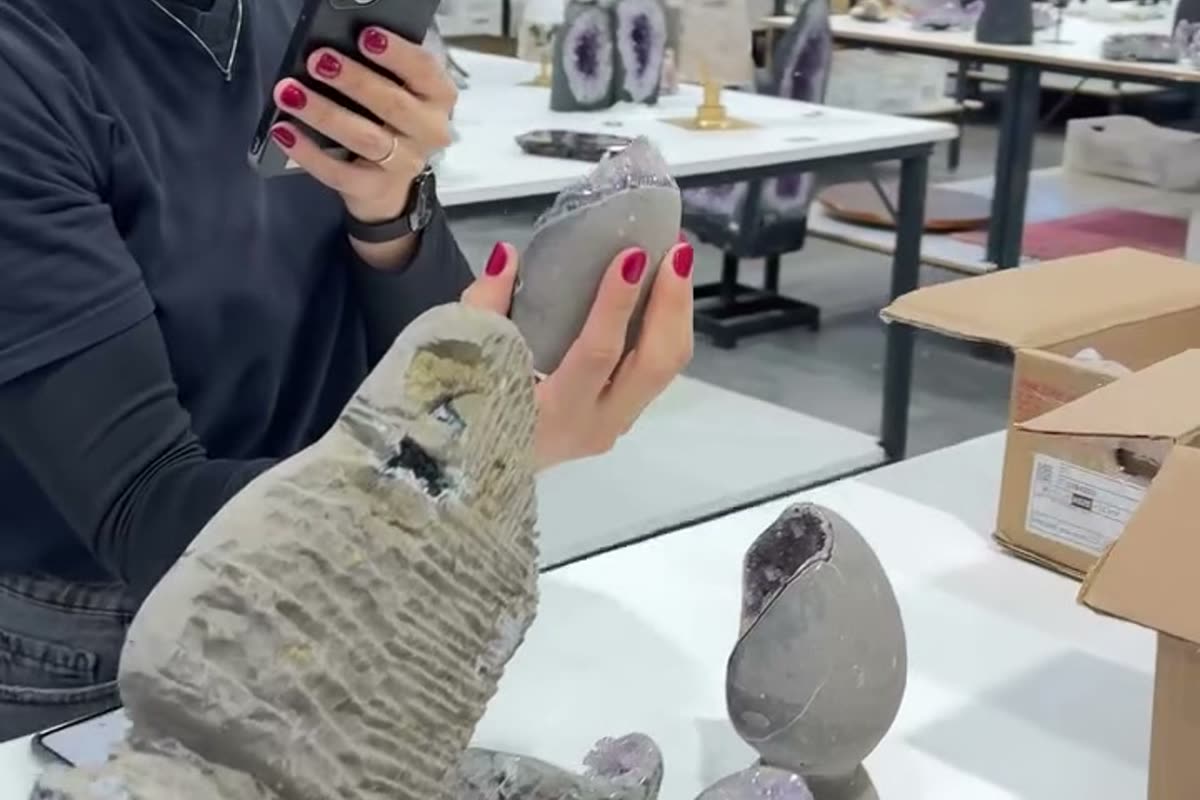
    A CS Minerals seller broadcasting a live sale on a phone from the company warehouse in Brazil, holding an agate piece to the camera
    The piece in the hand. A live sale running from the warehouse floor. This is what the format reproduces remotely: the actual unit, at scale, turning under ordinary light (with the rest of the inventory visible behind it. Photo: CS Minerals

    We set commercial terms (minimum order, payment terms, shipping mode and lead time) by buyer profile. After all, a jewelry maker buying rough by weight and a designer specifying one 300-kilogram cathedral place very different orders.

    Related reading: Wholesale Crystals for Metaphysical Stores, How to Buy Crystals Wholesale for Your Retail Business, Brazilian Amethyst Wholesale and Natural Stones for Architects and Designers.

    Brazilian Crystal Supplier: Frequently Asked Questions

    Yes. US retailers buy directly from Brazilian suppliers as a normal commercial practice. The retailer selects the material, the supplier packs and ships it by air or ocean freight, and the goods then clear US customs. The US buyer is the importer of record. Under DDP terms, however, the supplier handles duties and delivery.

    The most commonly exported categories are amethyst (clusters, geodes, cathedrals and polished pieces) and quartz in its several varieties (clear, smoky, rose and rutilated). Brazil also exports agate, tourmaline, beryls such as aquamarine and emerald, and topaz. Ornamental stone worked into spheres, towers, bowls, bookends and slabs completes the list.

    There is no single industry minimum. Suppliers set MOQ by order value, by weight or by piece count, and the figure depends on the category. Rough and bulk material usually carry weight-based minimums, while suppliers often sell unique statement pieces as single units. Ask any supplier which basis they use and whether it applies per SKU or per total order.

    By air freight or ocean freight. Air freight takes days, and carriers bill it by chargeable weight. It suits high-value, low-weight material and time-sensitive orders. Ocean freight takes weeks, and carriers bill it by volume or container. It is the practical option for heavy material such as geodes and slabs. Smaller ocean orders travel LCL, consolidated with other shippers.

    Retailers widely resell Brazilian material, largely because the range covers every price tier from inexpensive tumbled stones to individual display pieces. That range is what makes it workable for a retail assortment. The same supplier can provide both the volume products that drive traffic and the statement pieces that define a store.

    Ask for unedited photographs and video of the specific units, filmed in ordinary daylight with a scale reference in frame. Ask the supplier to state its grading criteria explicitly and to disclose any treatment. Heat-treated citrine, for example, is common and legitimate, but sellers must declare it. For a first order, request a smaller trial shipment and compare the goods received against the images and descriptions before committing to volume.

    Yes. CS Minerals supplies wholesale and professional buyers in the United States, including retail stores, online and live sellers, jewelry makers, designers and collectors. Wholesale access, catalog and commercial terms are available on request through the wholesale program page.

    Request Wholesale Access

    Looking for Brazilian crystals for your store, studio or project? Request wholesale access to CS Minerals to receive current availability, pricing and shipping options for the United States.

    About CS Minerals

    CS Minerals is a Brazilian supplier of crystals, minerals and natural stones serving wholesale buyers, retailers and professional buyers in the United States. The company combines Brazilian sourcing, product curation, live selling and international logistics to connect buyers with Brazilian stones and minerals.

    Written by the CS Minerals Wholesale Team · Last updated
    Photographs: CS Minerals, via @csminerals. This article is general commercial information, not customs, tax or legal advice. Confirm current tariff classifications and import requirements with a licensed customs broker before importing.

  • Who Is CS Minerals? Brazilian Crystals and Jewelry

    Who Is CS Minerals? Brazilian Crystals and Jewelry

    CS Minerals is a Brazilian supplier of crystals, minerals, and jewelry serving shops, resellers, and other businesses. The company brings over 25 years of experience in the production and commercialization of minerals and jewelry, with a collection that includes raw crystals, bracelets, and pendants. The minimum order is US$100.

    25+ years
    Experience in minerals and jewelry
    Brazil
    A Brazilian company serving businesses
    US$100
    Minimum order

    For a business choosing its next supplier, a beautiful piece is only the beginning. Buyers also need to understand what the company offers, whether the collection suits their customers, and how to take the first step toward an order. This introduction explains who CS Minerals is and provides a practical starting point for exploring the collection.

    What is CS Minerals?

    CS Minerals works with products that connect the mineral world with jewelry, collecting, and decorative use. Its collection brings together pieces people can wear, display, give as gifts, or offer to their own customers. That variety makes the company relevant to several kinds of retail business, rather than to one narrow product category.

    The company presents its range around authentic crystals and jewelry, including both raw crystals and more elaborate pieces. For example, a buyer might be looking for a distinctive specimen for a display, a wearable pendant, or bracelets to build out an existing jewelry selection. The right starting point therefore depends on the purpose of the purchase and the audience it will serve.

    A Brazilian company with a business focus

    CS Minerals serves stores and wholesalers and also welcomes people taking the first steps toward their own business. Its stated audiences include esoteric shops, crystal resellers, jewelry stores, and professionals working with interior design. These customers use mineral and jewelry products in different ways, so the most useful conversation begins with the buyer’s needs.

    To learn more about the company’s positioning and the markets it serves, visit the CS Minerals company introduction. There you can see how crystals and jewelry fit together within the collection and identify which part of the range you would like to explore first.

    What experience does CS Minerals bring?

    CS Minerals has over 25 years of experience in the production and commercialization of minerals and jewelry. This experience is part of the company’s background across the materials and finished products that shape its collection. For a prospective buyer, it offers context for the business behind the photographs and product categories.

    Experience is most useful when it leads to an informed conversation about the products you need. For instance, a reseller can explain the style of an existing collection, the type of customer who buys from the store, and the questions that commonly arise before a sale. A new business, on the other hand, can start with a simpler brief: its intended audience, initial budget, and preferred product categories.

    Turn your first conversation into a useful brief

    Instead of asking only for “some crystals,” describe how you plan to sell or use them. For example, a jewelry store might want pieces that work together in a display, while an interior designer may be seeking a specimen with particular dimensions. These are different requests, even when both begin with an interest in minerals.

    Share reference images when they help explain your preferences, and identify which details matter most. Color, size, finish, intended use, and budget are practical starting points. A clear brief makes it easier to discuss relevant options without assuming that every photographed product is currently available.

    Which CS Minerals products can you explore?

    The CS Minerals collection includes crystals, bracelets, pendants, and other mineral and jewelry pieces. Each category answers a different buying need. Before comparing individual items, decide whether your priority is a product to wear, a piece to display, or a mix that broadens what your business already offers.

    Crystals and mineral pieces

    Crystals can be the focus of a specialist shop, part of a broader gift selection, or a feature in an interior project. When reviewing a specific piece, look at its dimensions, shape, surface, and overall presentation. Ask for clarification about identification, origin, or treatment whenever those details will influence your purchase or your description to a customer.

    Bracelets and pendants

    Wearable pieces introduce another set of questions. For bracelets, dimensions and fit can be as important as visual appeal. For pendants, also check the size, materials, and exactly what is included with the item. Product photographs help communicate style, but a written description is useful for confirming details before an order.

    A quick guide to the collection
    Product category Possible role in your selection Details to discuss before ordering
    Crystals and mineral pieces Specialist collections, retail displays, or decorative projects Identification, dimensions, finish, and the specific piece or assortment offered
    Bracelets Wearable jewelry, gift selections, or a coordinated store display Size, fit, materials, and available variations
    Pendants Jewelry collections and individual statement pieces Dimensions, materials, fittings, and what is included

    Use the crystals and jewelry collection as an introduction to the range. Start with the category that best suits your purpose, then compare individual pieces using the same criteria. A consistent set of questions makes the options easier to evaluate.

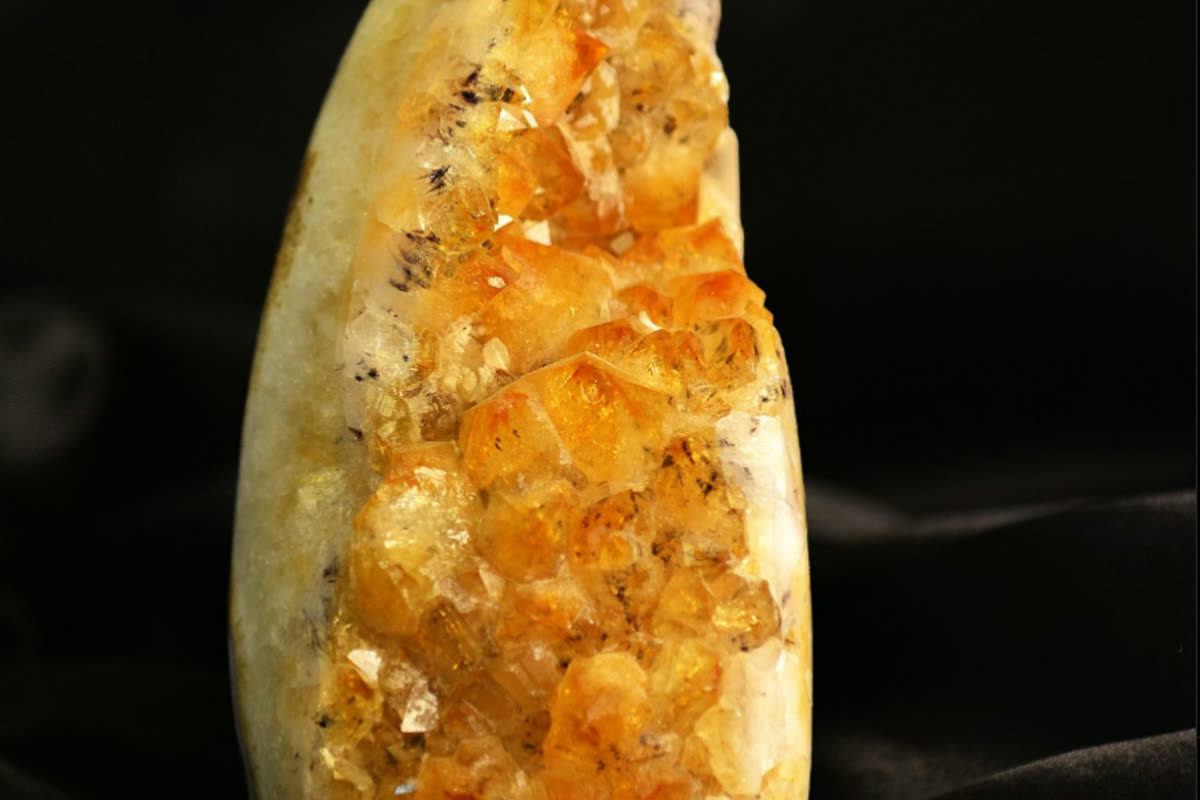
    Close detail of a golden citrine specimen from the CS Minerals selection
    A golden crystal specimen from the CS Minerals collection.

    Who does CS Minerals serve?

    The CS Minerals audience includes businesses that sell minerals and jewelry, along with professionals who select pieces for spaces and projects. The same product category can play a different role in each setting. Understanding that role helps a buyer choose with a purpose instead of assembling an unrelated assortment.

    Crystal resellers and esoteric shops

    A crystal reseller may be building a selection around mineral types, visual character, or the interests of an established customer base. Similarly, an esoteric shop may want pieces that fit its existing assortment and the way customers browse. In both cases, clear product identification and descriptions help customers understand what they are purchasing.

    Describe pieces through their observable qualities and the information available for each product. Names, dimensions, color, and form can give a customer a practical starting point, particularly when shopping online. Keep the description specific to the piece being offered so that the presentation is useful both to a knowledgeable collector and to a first-time buyer.

    Jewelry stores and interior design professionals

    For a jewelry store, bracelets and pendants can add variety in color, shape, and style. Consider how new pieces will sit alongside an existing collection and whether the assortment has a clear visual direction. For interior design, however, proportion and placement may lead the decision: a piece needs to make sense in the space for which it is intended.

    People starting their own business

    CS Minerals also assists people who are beginning a business. A first order can start with a focused idea rather than an attempt to serve every kind of customer. Define who you want to reach, select the categories that fit that audience, and use the discussion with the team to clarify your options before committing to an assortment.

    How do you choose a collection for your business?

    Choosing products becomes easier when you separate personal preference from a clear buying purpose. A piece you love may still need a particular customer, display, or explanation to work in your business. Start with the role of the collection, then use a short set of criteria to compare the available options.

    • Audience: Who is most likely to buy or use these pieces?
    • Purpose: Are you building a jewelry display, a crystal assortment, or a decorative project?
    • Product details: Which dimensions, materials, or identification details need confirmation?
    • Visual direction: Do the selected pieces have a useful relationship in color, scale, or style?
    • Budget: Does the proposed order fit your purchasing plan after the final quote is confirmed?
    • Presentation: What information and images will you need to describe the products accurately?

    Keep a first assortment focused

    A clear theme can make a small selection easier to present. For example, a store could begin by exploring pendants that suit its customers’ preferred style, or crystals chosen for a particular display area. In short, a focused starting point gives the buyer a useful way to compare options and explain the finished selection to customers.

    After choosing a direction, write down the questions that could change your decision. If exact dimensions matter, confirm them. If your customer expects a specific material or origin, ask for the relevant product information. Good preparation also helps keep the discussion concrete and reduces the temptation to infer details from a photograph alone.

    How do you start an order with CS Minerals?

    The minimum order at CS Minerals is US$100. Use that amount as the starting point for planning your purchase, then confirm the complete order details with the team. However, a minimum order value is not, by itself, a delivery quote or a statement about taxes, shipping, or payment arrangements.

    1. Define your request. Explain your business or project and the kinds of crystals or jewelry you want to explore.
    2. Discuss the available selection. Confirm which products or assortments are being offered and ask for details that matter to your purchase.
    3. Review the order value. Build a proposed selection that meets the US$100 minimum and suits your budget.
    4. Confirm the complete terms. Ask about payment, delivery availability, shipping charges, any applicable taxes, and the expected timeline for your order.
    5. Check the final details. Make sure the agreed products, quantities, and total are clear before proceeding.

    What should you include in your first inquiry?

    A useful inquiry can be short. State the type of business you run, the categories that interest you, and an approximate purchasing budget. Include your delivery destination when asking about shipping, because the team needs the actual order and destination to discuss the relevant arrangements.

    If you are still exploring, say so. You do not need to present a finished product list to begin a conversation. It is more helpful to describe your intended selection and ask specific questions than to assume that a photograph, a minimum order, or a general category page contains every commercial detail.

    What can you find through the CS Minerals VIP membership?

    CS Minerals presents its VIP membership as a way to hear about special offers, new product pre-releases, and special payment conditions. It is an option for buyers who want to stay connected to the collection beyond a single visit. Review the current information before joining so you understand how the program is being offered.

    The CS Minerals VIP membership is a useful next stop if those updates are relevant to your business. When an offer interests you, review the products involved and the conditions provided at the time. Consider how the selection fits your existing collection and purchasing plans before making an order decision.

    Frequently asked questions

    CS Minerals is a Brazilian supplier of crystals, minerals, and jewelry with over 25 years of experience in their production and commercialization. The company serves stores, wholesalers, crystal resellers, and other businesses, and also assists people starting their own business.

    The collection includes crystals, bracelets, pendants, and other mineral and jewelry pieces. Ask the team about current availability and the specifications of the products that interest you before placing an order.

    The minimum order is US$100. Confirm the complete order quote and any applicable delivery, tax, or payment details with the team before proceeding.

    Yes. CS Minerals serves established stores and wholesalers and also assists people taking the first steps toward their own business. Explain your intended audience, preferred product categories, and initial budget to make the conversation useful.

    Contact the team with your delivery destination and the products or assortment you are considering. Ask for the available delivery arrangements, charges, and expected timeline for that specific order.

    The VIP membership is presented as a way to access special offers, new product pre-releases, and special payment conditions. Check the current membership information and the terms of each offer with the company.

    Your next discovery starts here

    Get to know CS Minerals through its collection

    With over 25 years of experience in minerals and jewelry, CS Minerals brings together a range for shops, resellers, and other businesses. The next step is to connect that range with what your own customers or project need. Explore the collection, prepare a few product questions, and start a conversation around a selection that fits your purpose.

    The minimum order is US$100. Whether you are developing an existing assortment or preparing your first purchase, a clear request helps turn inspiration into a concrete order discussion. You can also follow CS Minerals on Instagram to see new pieces and live sales as they happen.

    Explore the collection

    Read also

    CS Minerals & jewelry Back to the journal Back to top