
By the CS Minerals Wholesale Team · Last updated
Brazilian agate wholesale is centered on Soledade, in Rio Grande do Sul, a town widely known as Brazil’s agate capital because so much of the world’s agate is cut, polished and exported from there. Buyers source slices, bookends, geodes, tumbled stones and decor pieces by the kilo or by the piece, in both natural and dyed colors. The key to buying well is knowing the formats, the grading logic and how to label dyed agate honestly.
Agate is one of the most versatile stones a retailer can carry. It works as a low-cost impulse item, a gift, a craft material and a decor centerpiece, often from the same lot. Because it is so common, the difference between a profitable agate line and a slow one usually comes down to the quality of your sourcing and the clarity of your labels.
Why Is Soledade Called the Agate Capital of Brazil?
Soledade sits on the plateau of northern Rio Grande do Sul, close to the agate and amethyst deposits hosted in the region’s volcanic basalts. Over generations, the town built an industry around stone: sorting, sawing, polishing, dyeing, carving and export. Today it is widely known in the trade as the agate capital of Brazil, and many visiting buyers see it as the main commercial hub for the state’s stone.
The reason is not only geology. It is the concentration of skills and businesses in one place. Workshops that saw slices, factories that polish geodes, carvers, dyers, packers and exporters all work within a short distance, which makes it efficient to consolidate many products into one shipment.
Where the agate itself comes from
Brazilian agate forms inside cavities in the Paraná flood basalts, the same volcanic sequence that hosts the amethyst geodes of Rio Grande do Sul. Silica-rich water filled the gas cavities over a very long time and deposited layer after layer of fine-grained quartz, which produces the bands agate is known for. Nodules are mined in the region and sent to towns like Soledade for processing.
For a wider view of how Brazil became a reference for crystals, see our article on the country famous for crystals.
The Idar-Oberstein Connection: How Brazilian Agate Reached the World
You cannot tell the story of Brazilian agate without Idar-Oberstein, the German town that was Europe’s great agate cutting center. By the early 1800s, its local agate deposits were largely worked out and the region faced hard times. Many families emigrated, and some went to southern Brazil.
According to local history, emigrants from Idar-Oberstein found rich agate deposits in Rio Grande do Sul in the 1820s, and by the 1830s Brazilian agate was already being shipped back to Germany. The rough often traveled as ballast in ships returning to Europe. The Brazilian material had very even, regular bands, which made it excellent for cameos and engraved stones.
The origin of agate dyeing
Idar-Oberstein cutters became masters at dyeing agate, because the porous layers of the stone absorb color unevenly and create strong, graphic bands. Those techniques spread and are still used today. This history matters for buyers: dyed agate is a long tradition, not a trick, but it is still a treatment that must be disclosed.
Over time, more and more of the processing moved to Brazil itself. Today, a buyer can source both the raw nodules and finished goods directly from Rio Grande do Sul without the material passing through Europe first.
Brazilian Agate Formats for Wholesale Buyers
Agate is sold in a wide range of formats. Each one fits a different part of a shop, a different customer and a different price point.
Agate slices
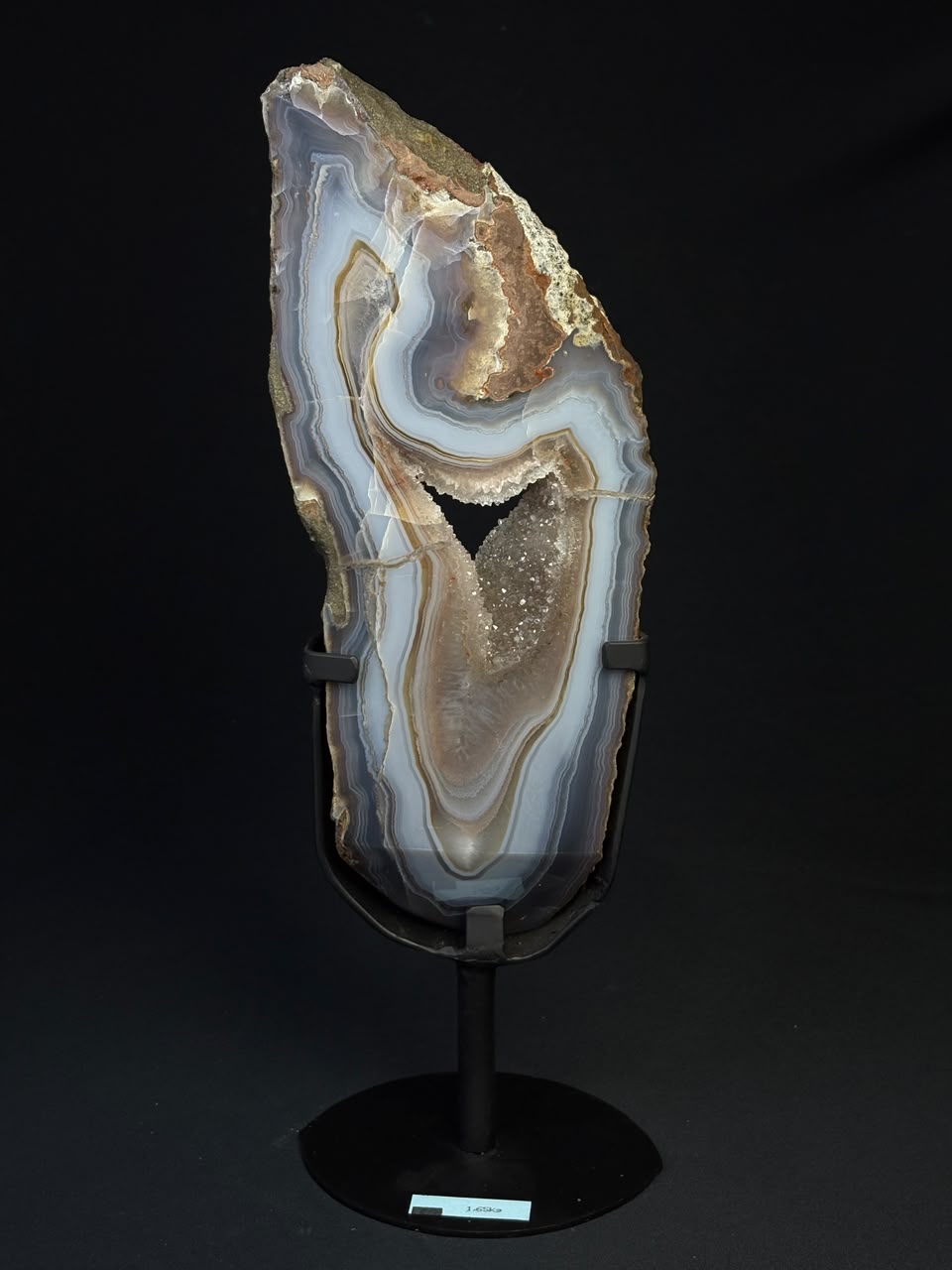
Agate slices are thin cross-sections of a nodule, polished on both faces, often with a natural rind edge. They are sold in size classes, by the kilo or by the piece. Slices are used as coasters, wall art, suncatchers, cake stands, wedding place cards and craft components, which makes them one of the most flexible items in any assortment.
Bookends
Agate bookends are a nodule or geode cut in half with a flat base on each side, so each half stands upright. Matching pairs sell well as gifts and in home decor stores. Weight, polish quality and how well the two halves match drive the price.
Agate geodes and nodules
Whole or halved agate geodes, often with a small quartz cavity inside, are affordable and popular with families and first-time buyers. Some retailers sell “crack your own” nodules as an experience product.
Tumbled stones, spheres and carvings
Tumbled agate is a steady low-price seller. Spheres, eggs, hearts, bowls and ashtrays add higher-ticket options. These belong to the carved and polished category and are usually quoted separately from natural slices.
Decor and functional pieces
Candle holders, clocks, lamp bases, coasters and trays made from agate are important for gift shops and interior retailers. They sell on design, so it pays to ask your supplier for current photos of finished items rather than ordering from a list.
For a full overview of other crystal categories that complement agate, see wholesale crystals by type.
Natural vs Dyed Agate: What Must Be Disclosed?
This is the single most important topic in agate buying. A large share of the colorful agate on the market is dyed. The bright blues, pinks, purples, teals and greens you see on slices and bookends are, in the great majority of cases, artificial colors.
Natural Brazilian agate tends to show grays, blue-grays, whites, creams, browns, tans and orange to reddish tones. Some agate is also heated to deepen red and orange shades. Neither dyeing nor heating is wrong, but both are treatments, and customers have the right to know.
| Feature | Natural color agate | Dyed agate |
|---|---|---|
| Typical colors | Gray, blue-gray, white, cream, brown, orange, red | Bright blue, pink, purple, teal, green, strong black |
| Color look | Soft, varied, often subtle | Saturated, uniform, sometimes neon |
| Where color sits | Follows natural bands | Strongest in porous bands, sometimes pooling at cracks |
| Main customer | Collectors, natural decor, crystal shops | Gifts, events, craft, color-matched decor |
| Labeling | “Natural agate” (confirm with supplier) | Must be labeled “dyed agate” |
How to tell dyed agate
- The color is too bright or too even for natural chalcedony.
- Color concentrates in cracks, pits or the more porous bands.
- Very similar color appears on many pieces in the same lot.
- The supplier describes the lot by color name, such as “blue” or “pink,” rather than by natural pattern.
Labeling in your shop
Simply write “dyed agate” or “agate, color-enhanced” on the label and in your online listing. In the US, the FTC Jewelry Guides expect treatments that affect value to be disclosed, and consumer protection rules in the UK, EU and Australia follow similar principles. Clear labels also protect you from bad reviews when a customer later learns the color was added.
How Is Brazilian Agate Graded and Priced?
As with most crystals, there is no universal grading standard for agate. Suppliers grade by a combination of visible features. Understanding them helps you compare quotes and avoid disappointment.
Pattern and banding
Crisp, well-defined bands, interesting patterns, eyes and fortification lines raise value. Dull, cloudy or featureless material sits lower. For slices, the whole face matters, not just the center.
Translucency
Slices that glow when held against light are more desirable, especially for window displays and suncatchers. Opaque material is still useful for coasters and decor.
Polish and cutting
A good polish should be glassy with no visible scratches. Slices should be of even thickness, without chips on the edge. Bookends should stand firmly and the halves should match.
Size and weight
Slices and small pieces are usually sold by the kilo in size classes. Bookends, geodes and decor items are more often priced per piece or pair. Always check the size range included in a kilo lot, because a lot of small slices and a lot of large slices can weigh the same and sell very differently.
- Higher grade: strong natural banding or striking pattern, translucent, excellent polish, no chips.
- Standard grade: good banding, good polish, minor edge chips acceptable.
- Commercial grade: weaker pattern or opaque, suited for craft, bulk and events.
We do not publish fixed prices because they move with exchange rates, supply and freight. For guidance on setting your own retail prices on agate and other stones, see how to price crystals to sell.
How to Buy Brazilian Agate Wholesale from Origin
Buying agate directly from Soledade gives you access to the widest range of formats and colors, and lets you combine agate with amethyst, citrine, quartz and other stones in the same shipment.
- Choose your formats and colors. Decide how much natural agate and how much dyed agate you want, and in which formats.
- Ask for photos of the actual lot. For kilo lots, a photo of the lot and a description of the size range are essential. For bookends and geodes, ask to see individual pieces.
- Confirm labeling. Ask the supplier to mark dyed material clearly on the quote and invoice so your team can label it correctly.
- Check packing. Thin slices can chip at the edges and bookends are heavy. Ask how items will be packed and request current shipping options and lead times for your destination.
- Check your import rules. Duties and taxes depend on your country and the product code. Check the official source for your market (US CBP, HMRC, EU TARIC, Australian Border Force).
New to wholesale buying? Our guide on where to buy Brazilian crystals wholesale compares the main channels.
Watching agate live
Agate is very visual, and lots can vary. At CS Minerals, the team runs live selling from the Soledade warehouse Monday to Friday, 8am to midnight Brazilian time, on Instagram @csminerals. You can ask to see slices against light, compare bookend pairs and check the colors before you order.
Selling Agate: Tips for Retailers
Agate rewards good merchandising. A few simple choices can turn a pile of slices into a profitable line.
- Use light. Hang translucent slices in windows or on light boxes so customers see the banding.
- Group by use. Show coasters, bookends and wall pieces as decor ideas, not just as stones.
- Separate natural and dyed. Display them in different areas with clear labels. Many collectors actively look for natural agate.
- Tell the story. The Idar-Oberstein connection and Soledade origin are real stories that help justify price and create interest.
Agate is traditionally associated with balance and grounding in many crystal traditions. You can mention this as tradition, but avoid presenting any health benefit as fact.
Frequently Asked Questions
Why is Soledade called the agate capital?
Soledade, in Rio Grande do Sul, concentrates a large number of businesses that sort, cut, polish, dye and export agate and other stones from the region’s basalt deposits. That concentration of skills and suppliers has made it widely known as Brazil’s agate capital. Many international buyers source agate there because they can combine many products in one shipment.
Is blue agate natural?
Bright blue agate slices and bookends are almost always dyed. Natural agate can show soft blue-gray tones, but not the strong, saturated blue common in decor pieces. Any dyed agate should be sold and labeled as dyed.
What is the connection between Brazilian agate and Idar-Oberstein?
Idar-Oberstein, in Germany, was a major agate cutting center whose local deposits were running out by the early 1800s. Emigrants from the region found large agate deposits in Rio Grande do Sul in the 1820s, and Brazilian agate was soon shipped to Germany for cutting and dyeing. Much of that processing later moved to Brazil.
More Questions
How are agate slices sold wholesale?
Agate slices are usually sold by the kilo in size classes, or by the piece for larger and premium slices. Price depends on size, pattern, translucency, polish and whether the color is natural or dyed. Ask for the size range included in each lot so you can compare quotes fairly.
Do I have to tell customers that agate is dyed?
Yes. Dyeing changes the appearance and value of the stone, and consumer protection rules in the US, UK, EU and Australia expect treatments like this to be disclosed. A clear “dyed agate” label is simple and protects your reputation.
Can I order agate together with other crystals?
Yes. Buying from a supplier in Soledade lets you combine agate with amethyst, citrine, quartz and other stones in one order. At CS Minerals the minimum order is US$100, which makes it easy to test a mixed first order.
Source Brazilian Agate from Soledade with CS Minerals
CS Minerals is based in Soledade, Rio Grande do Sul, and has 25 years of experience supplying crystals, minerals and natural stones to retailers. We offer agate alongside amethyst, citrine, quartz, geodes and many other materials, with international shipping and a minimum order of US$100. Watch our live selling from the warehouse Monday to Friday, 8am to midnight Brazilian time, on Instagram @csminerals.
See how to order wholesale crystals or browse the crystal catalog.